


CATEGORY
Getting started
One ship. One virus. Six stocks. 72 hours.
The Headline That Lit The Match

Earlier this month, passengers aboard the MV Hondius started getting sick while crossing the Atlantic.
Health officials later identified suspected cases tied to the Andes strain of hantavirus. A few deaths were reported. Two Americans were transported in biocontainment units.
The setup looked familiar.
COVID permanently rewired how markets react to health scares.
Back in 2020, the biggest money was made when vaccine names started ripping before the rest of Wall Street fully understood what was happening.
So now, every time a virus story hits the tape, traders immediately ask the same question:
“Which stock moves first if this becomes bigger?”
That reflex kicked in almost instantly last week.
Here’s the story ⇩
SPONSOR BREAK presented by BanyanHill*
44 Trillion “Super Convergence”: Elon’s Biggest Move EVER?
After being invited to the SpaceX launch headquarters in Cape Canaveral from one of Elon’s top lobbyists… Hall of Fame Trader Jon Najarian now says EVERYONE is missing an even bigger story about the SpaceX IPO… That it’s just the start of an Elon Musk $44 trillion “Superconvergence…” An event that could kick off as soon as June 9th.
Click here now to watch hall of fame trader Jon Najarian’s full prediction.
First — what is hantavirus? 🦠
Earlier this month, passengers aboard the MV Hondius — a cruise ship crossing the Atlantic — started getting sick.
Health officials identified seven cases of the Andes strain of hantavirus. Three people died. Seventeen American passengers were repatriated, two of them in biocontainment units.
Hantavirus in plain English: Hantaviruses are a family of viruses spread primarily by rodents. Most strains cannot pass between people at all. The Andes strain — found mainly in Argentina and Chile — is one of the rare exceptions where limited human-to-human transmission has been documented.
The WHO, CDC, and every major health organization said the same thing:
→ this is not another COVID.
→ It does not spread through the air.
→ It requires close, prolonged physical contact.
→ The total number of confirmed cases on the ship was seven.
That did not stop the market from reacting like it might be. ⇩
SPONSOR BREAK presented by BrownstoneResearch*
Millionaire warns: “Move your money now.”
Larry Benedict generated $274 million in profits for his clients by knowing where money flows when the Federal Reserve shifts.
He says Trump’s Fed Takeover is triggering the most significant shift in U.S. markets in nearly 20 years.
He’s already identified the one ticker he expects billions to flood into… and he’s giving away the name for free.
Click here to get the full details before the window closes.
The stocks — one by one
1 Moderna MRNA ( ▼ 0.77% ) – The most connected play
→ +12% Fri – May 8
→ +8% Mon AM – May 11
→ -3.6% Mon PM – May 11
Moderna is the only company in this group with a documented, active connection to hantavirus research. It disclosed that it has been conducting preclinical research on hantaviruses in collaboration with the US Army Medical Research Institute of Infectious Diseases and the Vaccine Innovation Center at Korea University — research that predates the outbreak entirely.
Moderna also lists both “Hantaan virus” and “Hantaviruses causing Hanta Pulmonary Syndrome” as permitted pathogens on its mRNA Access program, which lets researchers use its technology to develop vaccines. The mRNA platform that powered its COVID vaccine is theoretically adaptable to new pathogens quickly.
That is the real bull case here — not this specific outbreak, but the platform’s ability to respond to whatever comes next.
The reality check: analysts at Evercore ISI were blunt. “Hantavirus is a low-incidence, structurally small market. We see no meaningful revenue opportunity.”
Even if Moderna fast-tracked a vaccine, the total addressable market is a fraction of a fraction of what COVID represented.
→ Moderna sold $18.4 billion in vaccines in 2021. A hantavirus vaccine would not move that needle.
● Connection: Real — but revenue opportunity is minimal.
SPONSOR BREAK presented by MarketWise*
Massive 512,000-Line Data Leak Exposes Shocking AI Breakthrough
60-year Wall Street veteran and financial technology pioneer Marc Chaikin recently reviewed a massive data leak inside one of the world’s biggest AI labs. He discovered a hidden mechanism in the code that could create extraordinary wealth for savvy investors – and inflict grave financial hardships on everyone else. Click here for the full story.
2 Inovio Pharmaceuticals INO ( ▲ 1.49% ) – The 2011 grant story
Spiked premarket → -3.1% by close
Inovio’s connection to hantavirus is real — but old.
In 2011, the company received a US Defense Department grant to develop a device for delivering DNA vaccines, intended for testing against the Hantaan virus and other pathogens.
In 2015, several Inovio employees co-authored a paper evaluating the device’s efficacy, concluding it was a low-cost tool for rapid mass vaccination. Sounds promising.
The catch: that was 2015. Inovio has never produced a commercial product from this research — not a vaccine, not a treatment, not a single approved product tied to hantavirus.
The stock moved on a fifteen-year-old grant and a paper that never became a product.
● Connection: Technically real — commercially nonexistent.
3 Novavax NVAX ( ▲ 1.3% ) – The COVID association play
Spiked premarket → -5.4% by close
Novavax has no active hantavirus program. No research. No grants. No pipeline.
It moved purely because it was a COVID-era standout — the sole provider of an approved non-mRNA vaccine during the pandemic.
The market saw “health scare” and bought the last vaccine company it remembered winning.
By Monday afternoon, investors appeared to remember that association is not the same as relevance. Novavax gave back more than anyone else in the group.
● Connection: None — purely a COVID memory trade.
SPONSOR BREAK presented by Paradigm*
Altucher: This is My Favorite FREE Starlink Pre-IPO Ticker
Legendary investor James Altucher just gave out one of his TOP stock picks for the coming Starlink IPO – 100% FREE.
Usually he holds these plays “close to the vest”…
But with Starlink going public as soon as June 9th…
NOW is the time to act.
You can watch James’ latest video for yourself, right here.
It’s a brief, 3-minute video, and reveals the name and ticker symbol for FREE.
Click here to check it out now.
4 QuidelOrtho QDEL ( ▲ 3.08% )– The diagnostic play
Moved on diagnostic testing demand thesis
QuidelOrtho makes diagnostic testing equipment — the kind used to identify viruses quickly in clinical settings.
The thesis here is straightforward: if hantavirus spreads, demand for rapid diagnostic tests goes up, and QuidelOrtho is positioned to supply them. A reasonable logic chain, but one that requires a scale of outbreak that health officials say is extremely unlikely to materialize.
● Connection: Logical — but depends on an outbreak that experts say will not happen.
5 3M MMM ( ▼ 1.35% ) – The N95 play
Moved on PPE demand thesis
3M is one of the world’s largest suppliers of N95 respirator masks that became impossible to find in early 2020.
The hantavirus trade swept it up on the same PPE demand logic that drove mask manufacturers during COVID.
Like QuidelOrtho, the connection is real but contingent on a scale of outbreak that the evidence does not currently support.
● Connection: Real product — wrong scale of outbreak.
5 Carnival, Royal Caribbean & cruise stocks – The obvious losers
Declined on outbreak news
While biotech stocks spiked, cruise lines moved in the opposite direction — the most intuitive trade of the whole episode.
A virus originating on a cruise ship is bad for cruise ship bookings. The broader concern is that fearful travelers may get cold feet about upcoming trips.
However, analysts noted that cruise lines are already facing a much bigger headwind from spiking energy prices driven by the Iran war. Hantavirus added noise to an already difficult backdrop.
● Connection: Direct — but energy costs are the bigger problem
The Pattern:
What happened last week is not unusual.
Fear arrives faster than analysis. By the time the analysis catches up, the trade has already run.
The stocks that move most in these moments are not always the ones with the strongest connection to the actual event. They are the ones the market most strongly associates with the last time something similar happened.
The honest takeaway from last week is about how fear trades work — and how quickly the market corrects itself when the facts do not match the fear.
Don’t forget to to cast your vote 👇
Lesson Of The Day:

Was this email forwarded to you? Don’t miss out on future stories — subscribe using the button below.
Also, help your friends blossom this spring! Share us with them.
💬 We Want To Hear Your Story:
Got a market or stock you want us to analyze next?
Just drop your request in the comments here.
P.S. – If you no longer want to receive occasional emails from us and you want to unsubscribe, click here 👉 “Unsubscribe” . Thank you!
Not SpaceX
The Trade Before the Trade
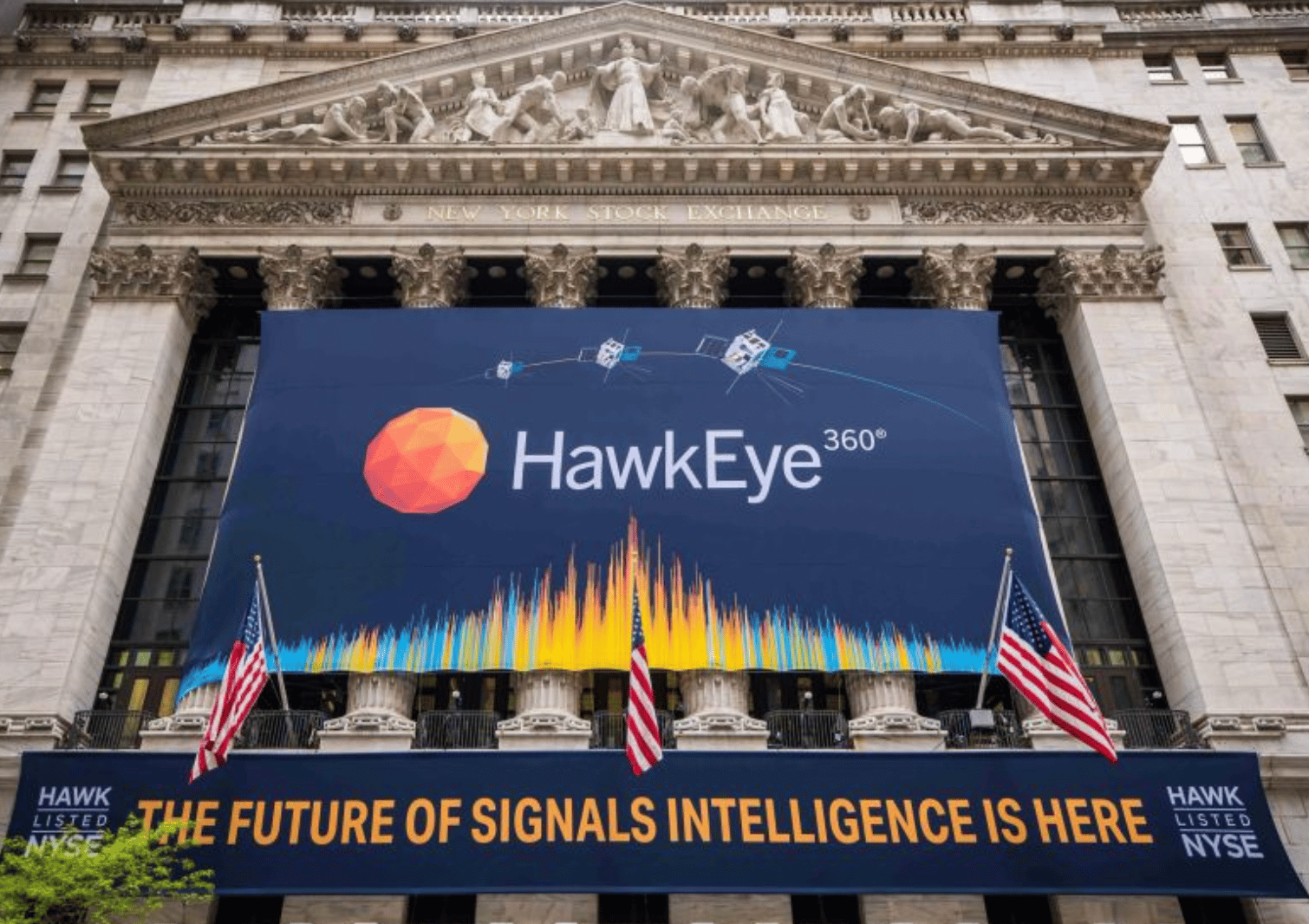
Everyone is staring at the menu waiting for SpaceX. But while you were deciding what to order, the appetizer just arrived — and it jumped 30% on the first day.
HawkEye 360 raised $416 million, priced at the top of its range, and immediately traded higher.
Not a household name and not a massive revenue story.
But a very clean signal.
Today we talk about HawkEye 360… and tomorrow we talk about the main course.
Here’s the story ⇩
SPONSOR BREAK presented by BrownstoneResearch*
Larry Benedict generated $274 million for his clients by finding the trade most missed.
He says The Final Phase of Elon’s Master Plan is about to trigger one of the biggest wealth transfers in market history.
He’s already identified the ONE ticker positioned to capture it. It isn’t SpaceX, Tesla, or anything you’d expect.
He’s giving away the name, free.
Click here to get the full details before the window closes.
The “Ears” in Orbit
Most satellites look down at earth.
HawkEye 360’s satellites listen.
The company operates a constellation of more than 30 satellites in low earth orbit, all designed to detect, locate, and analyze radio frequency emissions from anywhere on the planet.
Every ship, aircraft, military unit, and piece of electronic equipment on earth emits some kind of radio signal.
HawkEye HAWK ( ▲ 0.46% ) collects those signals, analyzes them, and sells the intelligence to the people who need it most:
→ defense agencies,
→ intelligence services, and
→ national security organizations around the world.
Founded in 2015 and based in Herndon, Virginia, HawkEye has spent a decade building its satellite constellation and its relationships with US government agencies. In December it acquired ISA, a firm specializing in signal processing and classified intelligence systems, deepening its ties with agencies that cannot be named publicly but whose budgets are not shrinking anytime soon.
SPONSOR BREAK presented by Paradigm*
Altucher: This is My Favorite FREE Starlink Pre-IPO Ticker
Legendary investor James Altucher just gave out one of his TOP stock picks for the coming Starlink IPO – 100% FREE.
Usually he holds these plays “close to the vest”…
But with Starlink going public as soon as June 9th…
NOW is the time to act.
You can watch James’ latest video for yourself, right here.
It’s a brief, 3-minute video, and reveals the name and ticker symbol for FREE.
Click here to check it out now.
The IPO (what just happened)
Here’s how the debut played out:
→ IPO price: $26
→ Open: ~$33.8
→ Day-one move: +30%
→ Capital raised: $416M
→ Valuation: ~$3.15B
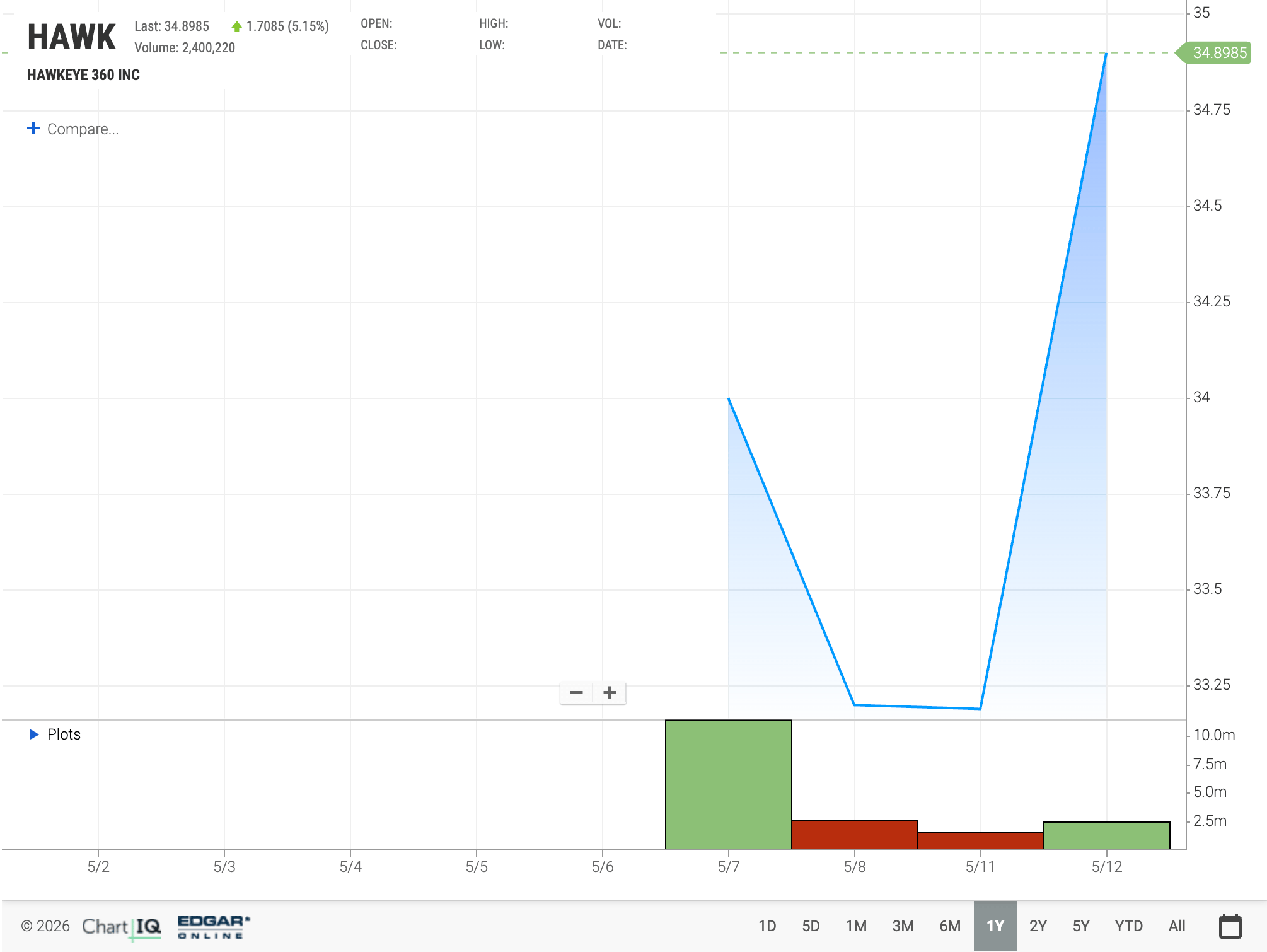
Two things stand out immediately:
It priced at the top of the range
It still popped hard on open
That combination usually means one thing:
institutional demand was strong before it even started trading
Goldman Sachs, Morgan Stanley, RBC Capital Markets, and Jefferies were among the underwriters — a blue-chip lineup that tells you the serious money took this listing seriously.
SPONSOR BREAK presented by BanyanHill*
$44 Trillion “Super Convergence”: Elon’s Biggest Move EVER?
After being invited to the SpaceX launch headquarters in Cape Canaveral from one of Elon’s top lobbyists… Hall of Fame Trader Jon Najarian now says EVERYONE is missing an even bigger story about the SpaceX IPO… That it’s just the start of an Elon Musk $44 trillion “Superconvergence…” An event that could kick off as soon as June 9th.
Click here now to watch hall of fame trader Jon Najarian’s full prediction.
The Valuation Question 🤔
This is where the story shifts.
HawkEye generates roughly:
→ ~$117M in revenue
→ ~$3.1B valuation
Which puts it at: → ~26x its annual revenue of $117 million.
To put that in context:
→ U.S. software average: trades at ~3.7x revenue
→ Even HawkEye’s closest peers in the defense tech space trade at around ~5.3x.
HawkEye is trading at five times that peer average.
What does 26x revenue actually mean?
When you buy a stock at 26x revenue, you are not paying for what the company earns today. You are paying for what you believe it will earn in the future, not current scale.
SPONSOR BREAK presented by BanyanHill*
Pre-IPO Access to America’s Top AI Defense Startup — for $50.
No waiting lists. No special status.
Just one 4-letter ticker that gives you a seat at the table.
Click here now to get the ticker + 3 steps to invest.
Bull vs Bear
1 The bull case is straightforward.
The Iran war has made signals intelligence one of the fastest-growing areas in defense spending. HawkEye’s customer base — US government and allied nations — is not going anywhere. And the company is still early in building out its constellation, meaning revenue should grow significantly as more satellites come online.
2 The bear case is equally clear.
At 26x revenue, a lot of that future growth is already priced in. If defense procurement priorities shift, if a larger competitor enters the space, or if growth disappoints, the valuation has a long way to fall. Government contracts are sticky — until they are not.
Neither case is obviously right. Both deserve to be taken seriously.
The SpaceX Connection 🚀
HawkEye did not go public in a vacuum.
The entire space technology sector is holding its breath waiting for SpaceX — the most anticipated IPO in years, targeting a valuation of over $1.75 trillion and a raise as large as $75 billion.
When SpaceX eventually files publicly, it will be the loudest rocket in a room that is already getting very crowded.
HawkEye’s debut tells us something important about that moment.
The market is hungry for space defense technology.
Institutional investors are willing to pay a significant premium for companies with government relationships and proprietary technology.
A 30% first-day pop at the top of the range is a preview of the appetite that exists for the right kind of space story.
What HawkEye cannot tell us is whether that appetite will survive the SpaceX listing itself. When a $1.75 trillion company enters the room, smaller players often get overshadowed — not because they are worse businesses, but because the oxygen in the room suddenly goes somewhere else.
Or SpaceX’s listing could do the opposite — validate the entire sector and lift every space stock alongside it. It has happened before in other industries when a dominant player goes public and draws fresh attention to the whole ecosystem.
Nobody knows which way it goes.
→ But HawkEye just proved the table is set.
!!! Tomorrow we talk about the main course. 👀
Don’t forget to to cast your vote 👇
Lesson Of The Day:

Was this email forwarded to you? Don’t miss out on future stories — subscribe using the button below.
Also, help your friends blossom this spring! Share us with them.
💬 We Want To Hear Your Story:
Got a market or stock you want us to analyze next?
Just drop your request in the comments here.
P.S. – If you no longer want to receive occasional emails from us and you want to unsubscribe, click here 👉 “Unsubscribe” . Thank you!
This IPO Runs on Coffee
The Habit…

Most people don’t think about capital markets at 7:30 in the morning.
They’re thinking about coffee — how fast they can get it, whether the line is moving, if their usual order is already waiting.
What feels like a routine… is actually one of the most efficient cash-flow machines in America.
And now, it’s heading back to Wall Street.
Dunkin’ is preparing to go public again — this time inside a private equity-built restaurant portfolio that looks a lot bigger than it actually is.
On paper, it’s diversification.
In reality, it’s something else.
Here’s the story ⇩
SPONSOR BREAK presented by Mode Mobile**
The Next Breakout Might Be in Your Pocket
Everyone’s hunting for the next Unicorn.
The type of “category disruptor” that grows fast and turns early believers into big winners.
59,000+ investors think that Mode Mobile could be one of those rare finds.
Americans spend 4 ½ hours on their phones daily, and Mode Mobile is monetizing that screentime. With $1B+ earned by over 490M customers and 32,481% revenue growth, Mode’s EarnPhone is turning smartphones into income generating assets.
Their previous raises sold out, and the company is now offering pre-IPO shares at $0.50/share with up to 20% bonus, exclusive to early investors.
Being early is everything, and this window is still open.
>> Review the offer before it closes
Disclaimers *Please read the offering circular and related risks at invest.modemobile.com.
Mode Mobile recently received their ticker reservation with Nasdaq ($MODE), indicating an intent to IPO in the next 24 months. An intent to IPO is no guarantee that an actual IPO will occur.
The Deloitte rankings are based on submitted applications and public company database research, with winners selected based on their fiscal-year revenue growth percentage over a three-year period.
**Please read InvestingPie, LLC’s full disclaimer in the footer.
The Dunkin’ Paradox
Inspire Brands presents itself as a collection of major restaurant concepts — six brands, global reach, billions in revenue. Structurally, it should behave like a diversified portfolio.
But diversification only works when each piece can stand on its own.
Here, one piece clearly does more than the rest.
Dunkin’ isn’t just part of the portfolio — it is the portfolio. The rest adds scale, but not equal contribution.

Dunkin’ has also been the only brand genuinely investing in its future. Since 2021 it has been rolling out next-generation stores with mobile order pickup, digital kiosks, and drive-thru upgrades — scaling from 1,000 updated locations to 4,000 by mid-2024.
The honest version of this IPO is not “buy a restaurant empire.” It is “buy Dunkin’ — and get five other brands you did not ask for.”
That is not necessarily bad. But it is worth knowing.
The Setup (what you’re actually looking at)
On paper, this is what the market is being asked to price:
→ ~33,300 locations globally
→ ~$33.4 billion in systemwide sales
→ ~$20 billion target valuation
Looks like scale.
Looks like diversification.
The Reality (what’s actually driving it)
Underneath that, the picture gets a lot simpler:
→ ~50% of the entire system = Dunkin’
→ $12.5 billion in U.S. sales alone
→ More than 2× Sonic
→ Nearly 3× Arby’s
→ Both Sonic and Arby’s declining year-over-year
That’s not diversification.
That’s concentration… with branding.
SPONSOR BREAK presented by Mode Mobile**
The Next Breakout Might Be in Your Pocket
Everyone’s hunting for the next Unicorn.
The type of “category disruptor” that grows fast and turns early believers into big winners.
59,000+ investors think that Mode Mobile could be one of those rare finds.
Americans spend 4 ½ hours on their phones daily, and Mode Mobile is monetizing that screentime. With $1B+ earned by over 490M customers and 32,481% revenue growth, Mode’s EarnPhone is turning smartphones into income generating assets.
Their previous raises sold out, and the company is now offering pre-IPO shares at $0.50/share with up to 20% bonus, exclusive to early investors.
Being early is everything, and this window is still open.
>> Review the offer before it closes
Disclaimers *Please read the offering circular and related risks at invest.modemobile.com.
Mode Mobile recently received their ticker reservation with Nasdaq ($MODE), indicating an intent to IPO in the next 24 months. An intent to IPO is no guarantee that an actual IPO will occur.
The Deloitte rankings are based on submitted applications and public company database research, with winners selected based on their fiscal-year revenue growth percentage over a three-year period.
**Please read InvestingPie, LLC’s full disclaimer in the footer.
The PE Playbook
This setup didn’t happen by accident.
In 2020, Roark Capital took Dunkin’ private for $11.3 billion. At the time, the company wasn’t broken — it was simply undervalued relative to what it could become.
That’s where private equity operates best.
1 Take the asset off the public market.
2 Improve what actually drives value.
3 Bring it back when the story is cleaner.
For Dunkin’, that meant focusing on efficiency — not reinvention.
Over the past few years:
→ Store formats were upgraded
→ Digital ordering expanded
→ Drive-thru throughput improved
The business didn’t change at its core. It just got better at what it already did.
Six years later, Roark wants to sell. And the asking price is $20 billion — nearly double what they paid.
The IPO Window
Inspire isn’t stepping into the market alone.
A growing list of companies that stayed private through 2025 are starting to move:
→ Jersey Mike’s filed for an IPO last month, targeting a valuation of at least $12 billion.
→ SpaceX is reportedly planning a listing that could value the company at over $1 trillion.
→ Several other consumer and retail companies have already gone public this year after a long drought.
The IPO market, which was essentially frozen through most of 2025 due to tariff uncertainty and market volatility, is thawing.
It is worth watching how the first few big listings actually trade before getting too excited.
SPONSOR BREAK presented by Paradigm*
Altucher: This is My Favorite FREE Starlink Pre-IPO Ticker
Legendary investor James Altucher just gave out one of his TOP stock picks for the coming Starlink IPO – 100% FREE.
Usually he holds these plays “close to the vest”…
But with Starlink going public as soon as June 9th…
NOW is the time to act.
You can watch James’ latest video for yourself, right here.
It’s a brief, 3-minute video, and reveals the name and ticker symbol for FREE.
Click here to check it out now.
The Timing Problem
But the backdrop isn’t entirely clean.
At the same time this IPO is coming together, some of the strongest operators in the space are starting to flag pressure on the consumer.
Higher gas prices.
Tighter budgets.
More selective spending.
Even companies like McDonald’s and Domino’s — which tend to hold up well across cycles — are acknowledging the shift.
Fast food sits in an interesting middle ground.
It feels essential.
But behaves like discretionary when conditions tighten.
Gas is heading toward $5 a gallon nationally. When that happens, the first thing consumers cut back on is discretionary spending.
Dunkin’ has proven more resilient, partly because its average ticket is lower than competitors and partly because coffee is the last habit people give up.
But the environment still matters.
And right now, those conditions are stable… but not easy.
Don’t forget to to cast your vote 👇
Lesson Of The Day:

Was this email forwarded to you? Don’t miss out on future stories — subscribe using the button below.
Also, help your friends blossom this spring! Share us with them.
💬 We Want To Hear Your Story:
Got a market or stock you want us to analyze next?
Just drop your request in the comments here.
P.S. – If you no longer want to receive occasional emails from us and you want to unsubscribe, click here 👉 “Unsubscribe” . Thank you!
AI… or Just a Better Story?
… just add AI.

Almost every single earnings call last week mentioned AI. Not once or as a footnote… but as the whole thesis.
→ DoorDash: AI will know what you want for dinner before you do.
→ CrowdStrike: AI will catch your hacker before they know they’ve been caught.
→ McDonald’s: AI is how we’re going to personalize your value meal.
→ Burger King: AI is how we’re going to fix the soda machine experience.
At some point you have to ask — is this a technology revolution or is “AI” just the new way to say “we have a plan” on an earnings call?
Let’s look at two companies where the answer actually matters.
One just proved the demand is real with 933 million orders.
The other is being priced like the proof already arrived — three weeks before they even report.
Here’s the story ⇩
SPONSOR BREAK presented by Brownstone*
Better than SpaceX? Grab this ticker instead.
Larry Benedict generated $274 million for his clients by finding the trade most missed.
He says The Final Phase of Elon’s Master Plan is about to trigger one of the biggest wealth transfers in market history.
He’s already identified the ONE ticker positioned to capture it. It isn’t SpaceX, Tesla, or anything you’d expect.
He’s giving away the name, free.
Click here to get the full details before the window closes.
Hungry?
Doordash DASH ( ▼ 4.03% ) reported 933 million orders in one quarter.

933 million orders… that’s the population of India ordering delivery.
DoorDash beat on earnings.
→ EPS came in at $0.42, beating estimates by 13%.
→ Revenue jumped 33% to $4.04 billion — slightly below forecasts but nobody cared because everything else was on fire.
→ Gross order value hit $31.6 billion, up 37%.
→ Record DashPass memberships.
→ Record monthly active users.
→ More first-time US consumers than any quarter before.
And Deliveroo — the British delivery app everyone thought was a distraction when DoorDash bought it — is now growing at its fastest rate in four years. Without Deliveroo, core GOV still grew 24%.
The mothership is healthy.
The stock jumped on earnings report 10%.
SPONSOR BREAK presented by BanyanHill*
Hidden in Tesla’s Filing: A $12 Billion “Super Startup”
Pull up Tesla’s most recent SEC filing. Page 5.
And you’ll see a single line showing $12 billion in revenue from a brand-new “super startup” Elon Musk has been quietly incubating inside Tesla.

This new “super startup” has nothing to do with cars or robots or space or AI…
But it sits at the center of what Blackstone calls “a $23 trillion investment opportunity.”
And on July 22, Elon is expected to pull back the curtain and reveal exactly what he’s building.
But Adam O’Dell already knows… and he reveals it all in this urgent video.
Built to Predict You
DoorDash’s co-founder and CEO, Tony Xu, has a bigger ambition than delivering your burrito.
He wants DoorDash to know what you want before you do. He calls it “agentic ordering” – AI that learns your habits well enough to order on your behalf.
Your usual Thursday night pad thai, your Sunday morning grocery run, your last-minute birthday cake. All of it, anticipated and handled before you even open the app.
To build that, DoorDash is doing something most companies talk about but never actually do – they’re tearing down their entire platform and rebuilding it from scratch. Several hundred million dollars. Runs into early 2027. Messy, expensive, and completely intentional.
They’re also building something called a digital catalog. Every restaurant dish, every grocery item, every product on every shelf — structured and searchable so an AI can make decisions on your behalf instantly.
That’s the long game.
The short game has a $50 million headache – driver gas relief costs from the Iran war-driven oil surge hitting Q2. Management says they’ll offset it elsewhere.
→ Q2 GOV guidance of $32.4B to $33.4B still came in ahead of Wall Street.
!!! The bull case is simple. DoorDash is no longer just food. It’s grocery, electronics, apparel, auto parts, restaurant reservations through SevenRooms. They’re building the operating system for the physical world. AI is just how they make it feel invisible.
The question is whether invisible is worth the price of rebuilding everything to get there.
SPONSOR BREAK presented by BehindTheMarkets*
Iran War TRUTH: There’s a strategy behind the Iran war.
I know because two private meetings with U.S. Congressmen on March 2nd — three days after the first missiles fell — sent me down a research path I wasn’t expecting.
What I found at the end of it: a coordinated operation, a shadow group running it, and one company at the dead center of all of it.
Click here to see the strategy behind the Iran war.
The market already wrote the ending.
CrowdStrike doesn’t report earnings until June 3.
The stock is already up 28% this month anyway.
CrowdStrike is a cybersecurity company. Their Falcon platform sits on top of companies’ entire digital infrastructure — endpoints, cloud workloads, identity, data — and watches everything in real time. Their AI tool, Charlotte, acts like a security analyst.
→ The business is genuinely strong.
→ Revenue growing 23% year over year.
→ EPS growing 30% annually.
→ They’ve beaten earnings estimates four quarters in a row.
The numbers are not the problem.
The problem is the price you’re paying for those numbers.
→ 98 times forward earnings.
→ A price-to-sales ratio of 24.76x against an industry average of 3.75x.
→ A DCF model that puts fair value at $357 while the stock sits at $468.

The stock is currently priced on what believers think it becomes.
Bull vs Bear.
The market got so excited about their AI story that it didn’t wait for the CrowdStrike numbers.
It just assumed. Priced it in. Moved on. That’s either the most confident trade of 2026 or the most expensive assumption.
Bulls say the stock is worth $692.
Bears say $113.

In short…
Nobody in tech invented anything new last week. AI was everywhere — in the earnings calls, in the guidance, in the stock prices.
DoorDash proved the demand is real. 933 million orders don’t lie.
CrowdStrike is betting the market stays patient long enough for the proof to catch up with the price. At 98x earnings, that’s not a small ask.
The AI revolution is happening. The question is who gets there first — and who was just really good at saying they would. 😉
Don’t forget to to cast your vote 👇
Lesson Of The Day:

Was this email forwarded to you? Don’t miss out on future stories — subscribe using the button below.
Also, help your friends blossom this spring! Share us with them.
💬 We Want To Hear Your Story:
Got a market or stock you want us to analyze next?
Just drop your request in the comments here.
P.S. – If you no longer want to receive occasional emails from us and you want to unsubscribe, click here 👉 “Unsubscribe” . Thank you!
All About The SpaceX IPO
This IPO Breaks Every Rule

The fine print on the SpaceX IPO is extraordinary.
→ You can’t sue.
→ You can’t vote.
→ You can’t fire Musk. The only person who can fire Musk is Musk.
And yet the line to get in stretches around the block.
SpaceX is expected to be the biggest IPO in history:
→ $75 billion in proceeds,
→ a $1.75 trillion valuation, and
→ an unusually generous 30% allocation for retail investors.
That last part almost never happens at this scale. Musk is letting everyday investors in early, which sounds generous until you read what you’re actually agreeing to.
Here’s the story ⇩
SPONSOR BREAK presented by Paradigm*
Altucher: This is My Favorite FREE Starlink Pre-IPO Ticker
Legendary investor James Altucher just gave out one of his TOP stock picks for the coming Starlink IPO – 100% FREE.
Usually he holds these plays “close to the vest”…
But with Starlink going public as soon as June 9th…
NOW is the time to act.
You can watch James’ latest video for yourself, right here.
It’s a brief, 3-minute video, and reveals the name and ticker symbol for FREE.
Click here to check it out now.
The Trade They Won’t Miss Twice
But before we get into the fine print, it’s worth asking why the line is so long in the first place.
One word: Tesla.
Back in 2010, Tesla went public at $17 a share.
Hold that through the noise, the volatility, the near-death moments… and you’re looking at ~42% annualized returns.
And for retail investors who missed it — or didn’t hold long enough — SpaceX feels like a second chance at the same bet.
This year, Tesla has been the second most traded stock by value among retail investors, accounting for roughly 30% to 40% of all discretionary trading volumes.

The “Musk faithful” are not a small group. They’re a market force. And after losing 30% of its value from mid-December to early April, Tesla is already back up 20% in the past month.
So what’s driving it?
→ Could be positioning into earnings.
→ Could be early anticipation around SpaceX.
→ Or it could be something simpler:
The same crowd… coming back.
Because when a trade changes people’s lives once, they don’t forget it.
And when the next version shows up — they don’t want to miss it twice.
SPONSOR BREAK presented by BanyanHill*
The REAL Reason Trump Is Invading Iran
For a moment… Forget about Trump’s ties to Israel. Forget about reports of Iran’s nuclear program.
Because my research has led me to believe we’re risking World War 3 with Iran for a completely different reason.
Click here to find out what it is.
If you have even a single dollar invested in the U.S. stock market, this is going to directly impact you.
Discover the reason here.
The Musk Multiplier
Both Tesla and SpaceX run on the same playbook.
Start with an idea most people dismiss as impossible.
Scale it like it’s inevitable.
Then tie compensation to numbers so big they sound like fiction.
At Tesla, the long-term target sits around $8.5 trillion.
At SpaceX, it’s roughly $7.5 trillion.
For context, the entire U.S. economy is about $28 trillion.
He wants both companies to be worth more than a quarter of that. Combined.
And yet retail is buying. Because Tesla already broke the template once.
And that changes how people process risk the second time around.

So when SpaceX goes public — possibly as soon as June — the question everyone is asking is what happens to Tesla.
→ Does retail trim their position to buy SpaceX?
→ Do they hold both?
→ Or does the excitement around SpaceX actually pull more money into the entire Musk ecosystem?
Nobody agrees.
1 Some experts say nothing changes — two great stories can coexist and retail capital rotates out of other things.
2 Others say something — Tesla holders trim a little, buy SpaceX, end up holding both.
3 And then there’s a third camp that says everybody wins — that SpaceX anticipation is already drawing retail back into Tesla, the same way SPACs pulled retail into anything celebrity-linked in 2021.
Back then, the company didn’t matter.
The association did.
This time, the association is Elon Musk.
And the story… is a lot bigger than cars – this one is aiming for Mars.
SPONSOR BREAK presented MarketWise*
Trump Admin to Pump $1 Billion into this “Off-the-Radar” AI Stock
The U.S. government pumped more than $1 billion into Intel. The stock popped 128%. It pumped $400 million into MP Materials. The stock popped 200%. It bought 10% of Trilogy Metals. The stock popped 500%. And now, Trump has chosen this AI stock for a $1 billion payday.
Click here for the full story and stock pick (free).
One Signature Away
There’s one more detail buried in the structure — and it matters more than it looks.
The same supervoting setup that gives Elon Musk ~83.8% control doesn’t just shape decisions.
It controls outcomes. Including M&A.
Which means, in theory, it opens the door to something bigger:
A potential merger between SpaceX and Tesla.
Two companies that already share the same narrative…
→ the same capital base…
→ and arguably, the same long-term vision.
In practice, they’re separate. But structurally?
They’re one approval away from being something else entirely.
And that’s the part most people skip over.
Now… about that fine print.
SPONSOR BREAK presented by BanyanHill*
Pre-IPO Access to America’s Top AI Defense Startup — for $50.
No waiting lists. No special status.
Just one 4-letter ticker that gives you a seat at the table.
Click here now to get the ticker + 3 steps to invest.
The Fine Print
Here’s what makes this IPO different from almost anything that’s come before it.
SpaceX is structured to move fast and stay focused.
→ No activist investors.
→ No proxy fights.
→ No shareholder proposals slowing things down.
The people building the rockets… stay in control of the rockets.
1 Elon Musk holds roughly 42.5% of the equity… but 83.8% of the voting power, thanks to supervoting shares that carry 10x the influence of a regular share.
So even as a public company, control doesn’t dilute.
The setup goes further.
2 SpaceX is incorporated in Texas — a state that’s been actively rewriting corporate rules to give founder-led companies more freedom to operate without the usual friction.
Disputes don’t play out in public courts.
They go through arbitration — faster, quieter, less disruptive.
3 And if you want a say as a shareholder?
You need real size.
At least $1 million in stock or 3% ownership just to bring a proposal forward.
So the tradeoff is pretty clear.
In short…
History doesn’t repeat itself. But Musk has a habit of making it rhyme.
SpaceX is asking you to believe again. Bigger stage. Same man.
The governance is unconventional. The valuation is enormous. And retail investors are getting a 30% allocation that almost never happens at this scale.
Shang Chou from Dishmi Capital said it best: ‘You focus less on valuation and more on the fact that you’ve been offered a seat on a rocket ship.’
The IPO lands as soon as June. The line forms to the left. 😉
Don’t forget to to cast your vote 👇
Lesson Of The Day:

Was this email forwarded to you? Don’t miss out on future stories — subscribe using the button below.
Also, help your friends blossom this spring! Share us with them.
💬 We Want To Hear Your Story:
Got a market or stock you want us to analyze next?
Just drop your request in the comments here.
P.S. – If you no longer want to receive occasional emails from us and you want to unsubscribe, click here 👉 “Unsubscribe” . Thank you!
The $5 Meal Economy 🍔
Same Menu… Different Reality

Four burger chains reported earnings this week.
→ One is on the best run in years.
→ One is quietly bleeding out.
→ One just went up in smoke.
→ And one is promising it’ll be fine by Christmas.
Welcome to the fast food earnings wars — where your lunch order is somebody’s stock price, the soda machine is a political statement, and a CEO eating a burger on camera can move markets more than a Fed announcement.
Here’s the story ⇩
SPONSOR BREAK presented by BanyanHill*
The REAL Reason Trump Is Invading Iran
For a moment… Forget about Trump’s ties to Israel. Forget about reports of Iran’s nuclear program.
Because my research has led me to believe we’re risking World War 3 with Iran for a completely different reason.
Click here to find out what it is.
If you have even a single dollar invested in the U.S. stock market, this is going to directly impact you.
Discover the reason here.
The Grind Paid Off
Burger King QSR ( ▲ 2.05% ) just had its best run in years.

US same-store sales jumped 5.8% ▲ — about five points ahead of the industry, and nearly two points ahead of McDonald’s.
But this wasn’t one of those “one good quarter” stories. This was four years of work finally showing up.
They called it Reclaim the Flame — a slow rebuild of the business:
→ fixing restaurants
→ cleaning up the menu
→ updating the brand
Nothing flashy. Just consistent upgrades, one piece at a time.
Even the Whopper got an upgrade – new bun, better mayo, fresher toppings.
And…crucially, a box instead of paper wrapping so it stops arriving smushed.
Customers had been asking for that for years.
BK president Tom Curtis listened. Literally. He posted his phone number on TikTok after going viral for taking an enthusiastic bite of the Whopper (the internet loved it), and ended up talking to 1,500 real customers.
His takeaway was simple: This isn’t a growing market. Every gain comes from somewhere else.
This quarter, most of it came from McDonald’s.
Even the soda machine became a signal.
While McDonald’s is pulling back on self-serve refills, Burger King is leaning into it.
“If they want a refill, they can have a refill.”
Nothing about this quarter looked accidental.
It just took a while to show up.
SPONSOR BREAK presented MarketWise*
Trump Admin to Pump $1 Billion into this “Off-the-Radar” AI Stock
The U.S. government pumped more than $1 billion into Intel. The stock popped 128%. It pumped $400 million into MP Materials. The stock popped 200%. It bought 10% of Trilogy Metals. The stock popped 500%. And now, Trump has chosen this AI stock for a $1 billion payday.
Click here for the full story and stock pick (free).
Beat With an Asterisk(*)
On paper, a clean beat.
→ Revenue topped estimates.
→ EPS cleared the bar.
→ US same-store sales grew for the fourth consecutive quarter.
→ Global systemwide sales hit $34 billion.
→ Loyalty program revenue crossed $9 billion across 70 markets.

By any traditional measure, McDonald’s MCD ( ▼ 0.05% ) had a good quarter.
The stock popped about 3% in premarket.
Then the tone shifted.
CEO Chris Kempczinski told analysts the consumer environment “may be getting a little bit worse.”
The pop evaporated.
But the real story isn’t in the beat. It’s in how McDonald’s is winning right now.
Value.
For nearly two years, the company has been stacking options:
→ $5 meal deal in 2024
→ $1 options in January 2025
→ A menu capped under $3 in April
→ $4 breakfast
Not one-off promos. A system built around tighter wallets.
As Kempczinski put it, customers have “a limited amount of money in their pocket.”
Even the Big Arch helped too. The oversized burger launched in March. The CEO’s tasting video made the rounds — mostly for the wrong reasons.
Still drove traffic. Sometimes attention works either way.
Then there’s the soda machine story.
Self-serve soda fountains are being phased out by 2032.
In their place: a new lineup of specialty drinks — refreshers, flavored sodas, customizable options — all priced to compete with chains like Starbucks and Dutch Bros.
The CosMc’s concept didn’t make it.
McDonald’s is the strongest chain in the world at capturing stressed consumers.
And right now, that means value.
The only question is how much further that shift goes.
SPONSOR BREAK presented by BanyanHill*
Pre-IPO Access to America’s Top AI Defense Startup — for $50.
No waiting lists. No special status.
Just one 4-letter ticker that gives you a seat at the table.
Click here now to get the ticker + 3 steps to invest.
The One That’s Bleeding Out.
Under the same RBI umbrella that just delivered Burger King’s best quarter in years, Popeyes is having its worst. The 6.5% comp drop is the biggest in multiple years. And it didn’t happen by accident — it happened by drift.

Here’s the diagnosis, laid out by Popeyes’ new US president Peter Perdue back in February. Think of it like a chain reaction — each failure feeding the next:
1 Step one: Popeyes leaned hard on limited-time offers to bring in new customers. It worked — new guests came in. But the complexity it added to operations was brutal. Service got slower and sloppier. The new guests didn’t come back. Neither did some of the loyal ones.
2 Step two: Chasing LTOs meant losing focus on the Louisiana heritage that made the brand. The core menu got blurry. The messaging got generic. Popeyes started to feel like any other chicken chain.
3 Step three: With identity weakened and service suffering, everyday value eroded. Price-sensitive customers — the backbone of fast food — stopped showing up.
One failure caused the next. → Classic chain reaction.
The fix is underway. Tighter chicken tender specs rolling out system-wide by June — early results show meaningful improvement in customer satisfaction.
→ A $5 Faves value offer.
→ Permanent Chicken Wraps at $3.99.
Kobza says Popeyes can return to positive comps by year-end.
Now the hard part is moving fast enough that customers give it another shot before forming new habits elsewhere.
SPONSOR BREAK presented by InvestorPlace*
Starting June 16, This AI Lab Could Take Off Dramatically
Time magazine recently named this lab “the most disruptive company in the world.” It’s not SpaceX or OpenAI. In fact, its annualized revenues have already surpassed both of these firms. And this 60-year Wall Street legend believes it’s gearing up for a watershed product launch that could send its sales soaring even higher starting June 16.
Click here to learn how you can access a “pre-IPO backdoor” into this firm for just $40 a share.
The One in Smoke.
Shake Shack SHAK ( ▼ 28.92% ) went down 30% in a single session. Worst day in the company’s history.

If you’re looking for what happens when a premium brand runs into a stretched consumer and rising costs at the same time— this is the case study.
The headwinds came from every direction at once.
→ Winter storms hurt Q1 traffic.
→ Beef costs rose in the low teens — record highs driven by dwindling US cattle supplies that have now hit multiple chains.
→G&A expenses jumped from $41M to $54M on marketing and
→ tech investments that didn’t show up in the results.
→ And the Middle East conflict is disrupting its licensed locations in the region — temporary closures, reduced hours, delivery-only operations, slowed inbound tourism at high-traffic locations.
Same-store sales actually grew 4.6%. In most quarters, that’s a good number. But Shake Shack needed 4.7%, and in a quarter where you’ve also swung to an operating loss and missed badly on EPS, almost isn’t close enough.
The structural problem here is what Shake Shack doesn’t have that McDonald’s does: a value floor.
When consumers tighten up, McDonald’s has a value layer to catch them.
Shake Shack doesn’t. There’s no safety net at the bottom of the menu. Premium positioning is a great place to be in a healthy consumer environment. But this isn’t one- with costs climbing and consumers counting dollars.
There’s no buffer.
And not much room to get it wrong.
In short…
What ties all four stories together is simpler than it looks: the consumer is under pressure, and every chain is being stress-tested by it.
Some were ready for it.
McDonald’s and Burger King spent the last few years reinforcing the basics — value, product, consistency.
That work is showing up now.
Disclaimer 😉:
No burgers were harmed in the making of this newsletter.
But a lot of lettuce was reconsidered.
Don’t forget to to cast your vote 👇
Lesson Of The Day:

Was this email forwarded to you? Don’t miss out on future stories — subscribe using the button below.
Also, help your friends blossom this spring! Share us with them.
💬 We Want To Hear Your Story:
Got a market or stock you want us to analyze next?
Just drop your request in the comments here.
P.S. – If you no longer want to receive occasional emails from us and you want to unsubscribe, click here 👉 “Unsubscribe” . Thank you!
Nobody Had These On Their Bingo Card 👀
The Market Finally Caught Up

In 2001, Corning was dying.
The internet bubble had just burst, and demand for fiber optic cables — Corning’s entire business — collapsed almost overnight.
Revenue fell 70% in a single year.
The stock dropped 99% from its peak.
Employees were laid off by the thousands.
The company that had been making specialty glass since 1851 was suddenly fighting for its life.
The painful irony? Corning was not failing because fiber optics was a bad idea. It was failing because the world was not ready for it yet. The infrastructure was being built decades too early — before there was enough internet traffic to justify it, before streaming existed, before anyone had a smartphone in their pocket.
Fast forward 25 years, and Jensen Huang just wrote Corning a $500 million check.
Because the world is finally ready. And this time, there is not enough fiber — not even close.
Here’s the story ⇩
SPONSOR BREAK presented by BanyanHill*
Pre-IPO Access to America’s Top AI Defense Startup — for $50.
No waiting lists. No special status.
Just one 4-letter ticker that gives you a seat at the table.
Click here now to get the ticker + 3 steps to invest.
WHY?
As AI data centers grow bigger and more powerful, the amount of data moving between chips, servers, and buildings becomes almost incomprehensible.
Copper cables — the traditional wiring inside data centers — have a speed and distance problem at that scale.
Fiber optics solves it.
Think of it like this:
Copper is a garden hose. Fiber is a fire hydrant. When you are trying to move the entire internet’s worth of data between AI servers in real time, you need fire hydrants — a lot of them. Nvidia is building the biggest city in history and just realized it is running out of fire hydrants. Corning makes fire hydrants. Jensen just locked in the supply before everyone else figures out they need the same thing.
As part of the deal, Corning GLW ( ▲ 12.01% ) will build three new US factories, expanding optical connectivity manufacturing by 10x and fiber production by 50%.
Nvidia is buying 3 million Corning shares at essentially zero — $0.0001 each — and has warrants to buy 15 million more shares at $180 each within three years.
Translation: if Corning’s stock keeps climbing, Nvidia profits twice. Once from the partnership. Once from the equity.
Corning jumped 12% today and hit an all-time high.
It is already up more than 100% this year.
And most investors still could not pick its ticker out of a lineup.
Worth noting: this is not a one-off. Nvidia has also invested $2 billion each into Marvell MRVL ( ▲ 2.02% ) , Coherent COHR ( ▲ 2.66% ) , and Lumentum LITE ( ▼ 5.06% ) — all fiber and optical communications companies. Jensen is systematically locking in the supply chain that makes his chips actually useful at scale, one check at a time.
SPONSOR BREAK presented by BanyanHill*
The REAL Reason Trump Is Invading Iran
For a moment… Forget about Trump’s ties to Israel. Forget about reports of Iran’s nuclear program.
Because my research has led me to believe we’re risking World War 3 with Iran for a completely different reason.
Click here to find out what it is.
If you have even a single dollar invested in the U.S. stock market, this is going to directly impact you.
Discover the reason here.
Nobody bet on this one.
For the last two years, the spotlight hasn’t really moved.
1 GPUs took it and held it. They trained the models, handled the heavy lifting, and turned Nvidia into the center of the trade. Everything else felt secondary.
2 CPUs were still there — just not part of the conversation.
That’s starting to change.
Advanced Micro Devices AMD ( ▲ 18.62% ) jumped 16% this week, and the focus wasn’t on GPUs. It was on CPUs — the chip that sits inside just about everything.
The shift is subtle, but it’s important.
Training a model is one thing. Running it millions of times a day is something else entirely.
That’s where CPUs start to show up again.
The CPU-to-GPU mix used to lean heavily one way — sometimes as wide as one-to-eight. Now it’s moving closer to even.
That kind of change doesn’t stay isolated.
AMD raised its estimate for the CPU server market to $120 billion by 2030. Analysts adjusted just as quickly.

Nothing flashy about it.
Just a different part of the system getting a lot more attention. 👀
SPONSOR BREAK presented by InvestorPlace*
Trump Just Named His Secret AI Project. It’s Called “Golden Dawn.”
When a secretive project gets a name, it means we’re closer to a breakthrough than most people think. Behind the razor wire of a hidden government lab in Tennessee, 40,000 scientists are finishing work on an AI computer 283 trillion times more powerful than today’s data centers — spanning more than 700 miles and built to speed up AI breakthroughs by 36,000%. When Golden Dawn launches, it could instantly leapfrog ChatGPT, Gemini, and Grok — and trigger a $100 trillion reset of the AI markets. Louis Navellier is revealing the one stock at the center of it — down to the ticker — but only through May 5th.
It Was Supposed to Turn

Micron Technology makes memory chips — the component that allows computers to hold and quickly access information.
Historically, memory has been one of the most punishing businesses in tech. Strong demand, oversupply, collapse… then do it all over again. Investors learned to expect it.
But something broke that cycle.
Micron MU ( ▲ 4.12% ) just crossed a $700 billion market cap. It is up 690% over the past year.
What changed is where the demand is coming from.
Training models is only the first step. Once they’re deployed, they need to constantly read, write, and update information in real time.
That’s a different kind of workload. And it doesn’t really pause.
Companies like Meta, Microsoft, and Apple all pointed to the same pressure last week — rising memory costs.
Three of the largest technology companies on earth.
→ Same complaint. → Same week.
As one analyst put it, the driver this time looks more persistent.
SPONSOR BREAK presented by BanyanHill*
Hidden in Tesla’s Filing: A $12 Billion “Super Startup”
Pull up Tesla’s most recent SEC filing. Page 5.
And you’ll see a single line showing $12 billion in revenue from a brand-new “super startup” Elon Musk has been quietly incubating inside Tesla.
This new “super startup” has nothing to do with cars or robots or space or AI…
But it sits at the center of what Blackstone calls “a $23 trillion investment opportunity.”
And on July 22, Elon is expected to pull back the curtain and reveal exactly what he’s building.
But Adam O’Dell already knows… and he reveals it all in this urgent video.
The landlord lesson…
Hut 8 HUT ( ▲ 35.31% ) started as a bitcoin miner — rows of machines, cheap power, solving math problems for crypto.
Not exactly where you’d expect a $9.8 billion lease to show up.
Somewhere along the way, the business shifted.
Hut 8 realized that what it actually had was something far more valuable than bitcoin: land, power, and the infrastructure to run enormous amounts of compute.
In this market, that’s a different category entirely.
Today, Hut 8 signed a 15-year, $9.8 billion lease for its Texas AI data center campus. The tenant wasn’t named. Just described as “high-investment-grade.”
Someone willing to commit nearly $10 billion without putting their name on it.
The stock jumped 34% before lunch.
Same day, earnings missed expectations.
About today…
Every company that won big today — Corning, AMD, Micron, Hut 8 — is not trying to build artificial intelligence. They are building the physical world that artificial intelligence needs to exist.
→ Fiber to move the data.
→ Memory to hold it.
→ CPUs to process the decisions.
→ Power and land to run it all.
The AI boom is the biggest construction project in human history. And for two years, the market rewarded the architects while largely ignoring the construction crew.
Today, the construction crew had a very good day.
And based on the checks being written, the leases being signed, and the market estimates being doubled overnight — it is just getting started. 👀
Don’t forget to to cast your vote 👇
Lesson Of The Day:

Was this email forwarded to you? Don’t miss out on future stories — subscribe using the button below.
Also, help your friends blossom this spring! Share us with them.
💬 We Want To Hear Your Story:
Got a market or stock you want us to analyze next?
Just drop your request in the comments here.
P.S. – If you no longer want to receive occasional emails from us and you want to unsubscribe, click here 👉 “Unsubscribe” . Thank you!
Applause (Not Included)
When winning is not enough

Imagine you ran a marathon, finished in the top 1%, broke your personal record by 20 minutes, and crossed the finish line to find the crowd booing.
That is roughly what happened to Palantir this week — a company that posted: → 85% revenue growth,
→ 150% earnings growth,
→ raised its full-year guidance, and
→ closed 206 deals worth at least $1 million each in a single quarter, only to watch its stock slide 7% as investors shrugged and moved on.
So what went wrong? To answer that, you have to understand what the market is quietly doing to software companies right now.
Over the past year, investors have developed something close to an allergy toward profitable, cash-generating software businesses, driven by a single uncomfortable question that AI has introduced into every boardroom and every earnings call: what if this software gets replaced?
Palantir has spent years building platforms that help governments and corporations make sense of enormous, messy datasets. Embedded so deeply into military intelligence operations and hospital systems that ripping it out would be genuinely painful. The US government relies on it. And with the Iran war making the defense pitch write itself, that business has never been stronger.
Here’s the story ⇩
SPONSOR BREAK presented by InvestorPlace*
The REAL Reason Trump Is Invading Iran
For a moment… Forget about Trump’s ties to Israel. Forget about reports of Iran’s nuclear program.
Because my research has led me to believe we’re risking World War 3 with Iran for a completely different reason.
Click here to find out what it is.
If you have even a single dollar invested in the U.S. stock market, this is going to directly impact you.
Discover the reason here.
BUT…
1 OpenAI and Anthropic are now knocking on the same corporate doors, offering something faster, cheaper, and increasingly capable of doing the same translation — and that threat, even if it remains years away from being real, is enough for investors to quietly wonder whether Palantir is the last generation of this kind of software rather than the first generation of the next one.
That is a brutal place to be, even when every metric is pointing up.

2 There is another layer to this. The retail crowd that turned Palantir into a cult stock — responsible for 25% of daily trading volume a year ago — has quietly stepped back, accounting for just 13% today.
The meme energy is fading. What remains is a genuinely strong business carrying a still-elevated valuation into an uncertain competitive landscape.
SPONSOR BREAK presented by InvestorPlace*
Trump Just Named His Secret AI Project. It’s Called “Golden Dawn.”
When a secretive project gets a name, it means we’re closer to a breakthrough than most people think. Behind the razor wire of a hidden government lab in Tennessee, 40,000 scientists are finishing work on an AI computer 283 trillion times more powerful than today’s data centers — spanning more than 700 miles and built to speed up AI breakthroughs by 36,000%. When Golden Dawn launches, it could instantly leapfrog ChatGPT, Gemini, and Grok — and trigger a $100 trillion reset of the AI markets. Louis Navellier is revealing the one stock at the center of it — down to the ticker — but only through May 5th.
Flip the coin and…
As Palantir has too much competition… Apple has too little supply… it ran out of chips.
Apple has quietly begun shopping for backup chip suppliers, and the fact that this is even necessary tells more about the state of the AI race.
According to Bloomberg, Apple executives held early-stage talks with Intel INTC ( ▲ 12.91% ) and visited Samsung’s chip plant in Texas, all in search of an alternative to TSMC, the Taiwanese manufacturer that has produced Apple’s main processors for over a decade.
→ Intel jumped nearly 14% on the news alone, which is a remarkable reaction to a conversation that produced no agreement, no contract, and no commitment — and which tells exactly how desperate the market is for anyone capable of making more advanced chips at scale.
SPONSOR BREAK presented by BanyanHill*
Hidden in Tesla’s Filing: A $12 Billion “Super Startup”
Pull up Tesla’s most recent SEC filing. Page 5.
And you’ll see a single line showing $12 billion in revenue from a brand-new “super startup” Elon Musk has been quietly incubating inside Tesla.
This new “super startup” has nothing to do with cars or robots or space or AI…
But it sits at the center of what Blackstone calls “a $23 trillion investment opportunity.”
And on July 22, Elon is expected to pull back the curtain and reveal exactly what he’s building.
But Adam O’Dell already knows… and he reveals it all in this urgent video.
In the same queue.

The reason Apple is looking around is that TSMC simply cannot keep up with demand. Amazon, Google, and Microsoft are spending hundreds of billions building AI infrastructure, and they are all standing in the same queue as Apple.
Tim Cook said it plainly on last week’s earnings call — supply constraints are actively limiting iPhone and Mac sales right now.
So Apple did what any rational person does when their favorite restaurant is fully booked. It started looking at other options. And Intel and Samsung are those options.
However…
1 Intel is still in the early stages of a long and expensive foundry turnaround.
2 Samsung is a distant second in the market. These remain exploratory conversations with no deals signed.
And yet Intel jumped nearly 14% on the news… without a contract or a partnership. Just on the possibility of a phone call.
Now pull back and look at the whole picture… the compute shortage powering the AI boom is not a short-term bottleneck — it is a structural gap that will take years and hundreds of billions of dollars to close, and that anyone who can help close it will be rewarded accordingly.
SPONSOR BREAK presented by BehindTheMarkets*
Companies are already delaying their IPOs. Why?
Because the SpaceX offering is expected to absorb nearly all the capital in the market.
Bloomberg reported the shift. Citigroup just joined the underwriting team.
The raise could hit $50 billion. But the smart money isn’t just buying the IPO.
They’re positioning into the one chokepoint supplier this $1.75 trillion empire depends on to stay online.
Most investors will see it after the move.
The thread that ties it all together:
Here is what both stories are really saying.
The AI boom is the biggest construction project in human history. And right now, the market is paying a fortune for anyone selling shovels (chips, power, infrastructure) and asking hard questions of anyone selling blueprints.
The foundations are still being poured, and the world needs more concrete before it needs more architects. The companies that figure out which side of that line they are on, and move accordingly, are the ones worth paying attention to in the next 12 months.
Palantir sells blueprints. Apple needs shovels.
Intel just realized it might be sitting on a shovel factory.
The rest is just details. 👀
Don’t forget to to cast your vote 👇
Lesson Of The Day:

Was this email forwarded to you? Don’t miss out on future stories — subscribe using the button below.
Also, help your friends blossom this spring! Share us with them.
💬 We Want To Hear Your Story:
Got a market or stock you want us to analyze next?
Just drop your request in the comments here.
P.S. – If you no longer want to receive occasional emails from us and you want to unsubscribe, click here 👉 “Unsubscribe” . Thank you!
The Most Expensive “What If” Ever
The Spoiler Alert…

Before we talk numbers, we need to talk about Charlie Munger.
Munger — Warren Buffett’s right hand for 45 years, the guy who turned “I’m just a poor man’s Buffett” into a philosophy — once said something that aged so well it should be in a museum:
“When a manager with a reputation for brilliance tackles a business with a reputation for bad economics, it is the reputation of the business that remains intact.”— Charlie Munger
Translation: it doesn’t matter how smart you are. A bad business will humble you every time.
Keep that in your back pocket. We’re coming back to it.
Here’s the story ⇩
SPONSOR BREAK presented by InvestorPlace*
Trump Just Named His Secret AI Project. It’s Called “Golden Dawn.”
When a secretive project gets a name, it means we’re closer to a breakthrough than most people think. Behind the razor wire of a hidden government lab in Tennessee, 40,000 scientists are finishing work on an AI computer 283 trillion times more powerful than today’s data centers — spanning more than 700 miles and built to speed up AI breakthroughs by 36,000%. When Golden Dawn launches, it could instantly leapfrog ChatGPT, Gemini, and Grok — and trigger a $100 trillion reset of the AI markets. Louis Navellier is revealing the one stock at the center of it — down to the ticker — but only through May 5th.
The Offer
Six months ago, Ryan Cohen stood in front of GameStop shareholders and told them he was looking for an acquisition that could be “genius or totally, totally foolish.“
Most people laughed. The meme stock guy, the one who turned a dying video game retailer into a cash machine through sheer stubbornness, was going shopping. How big could he really go?
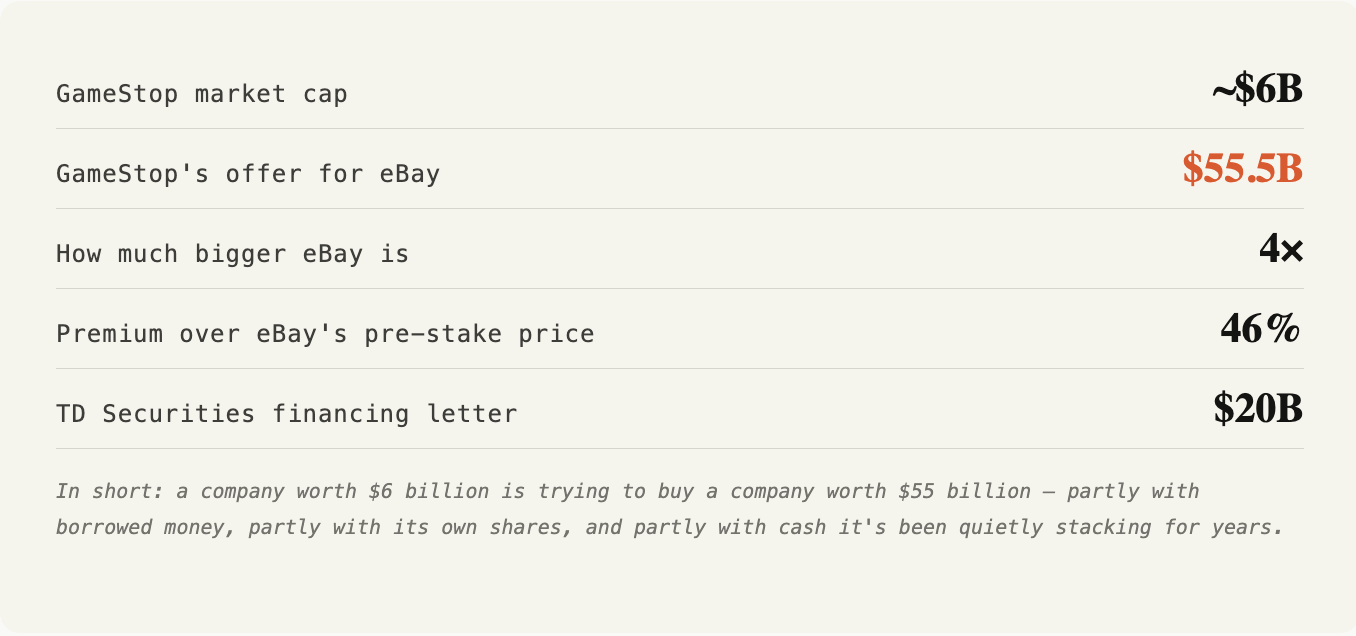
$55.5 billion, as it turns out.
On Sunday evening, GameStop submitted a formal offer to acquire eBay — the original online auction house, the website that taught an entire generation that strangers on the internet would actually mail you things.
The offer is $125 per share, a 46% premium to where eBay was trading before Cohen started quietly accumulating a 5% stake in the company.
Nobody knew he was building it. Months of silence, then a $55 billion letter in your inbox on a Sunday night.
SPONSOR BREAK presented by BanyanHill*
Hidden in Tesla’s Filing: A $12 Billion “Super Startup”
Pull up Tesla’s most recent SEC filing. Page 5.
And you’ll see a single line showing $12 billion in revenue from a brand-new “super startup” Elon Musk has been quietly incubating inside Tesla.
This new “super startup” has nothing to do with cars or robots or space or AI…
But it sits at the center of what Blackstone calls “a $23 trillion investment opportunity.”
And on July 22, Elon is expected to pull back the curtain and reveal exactly what he’s building.
But Adam O’Dell already knows… and he reveals it all in this urgent video.
The Absurd Math
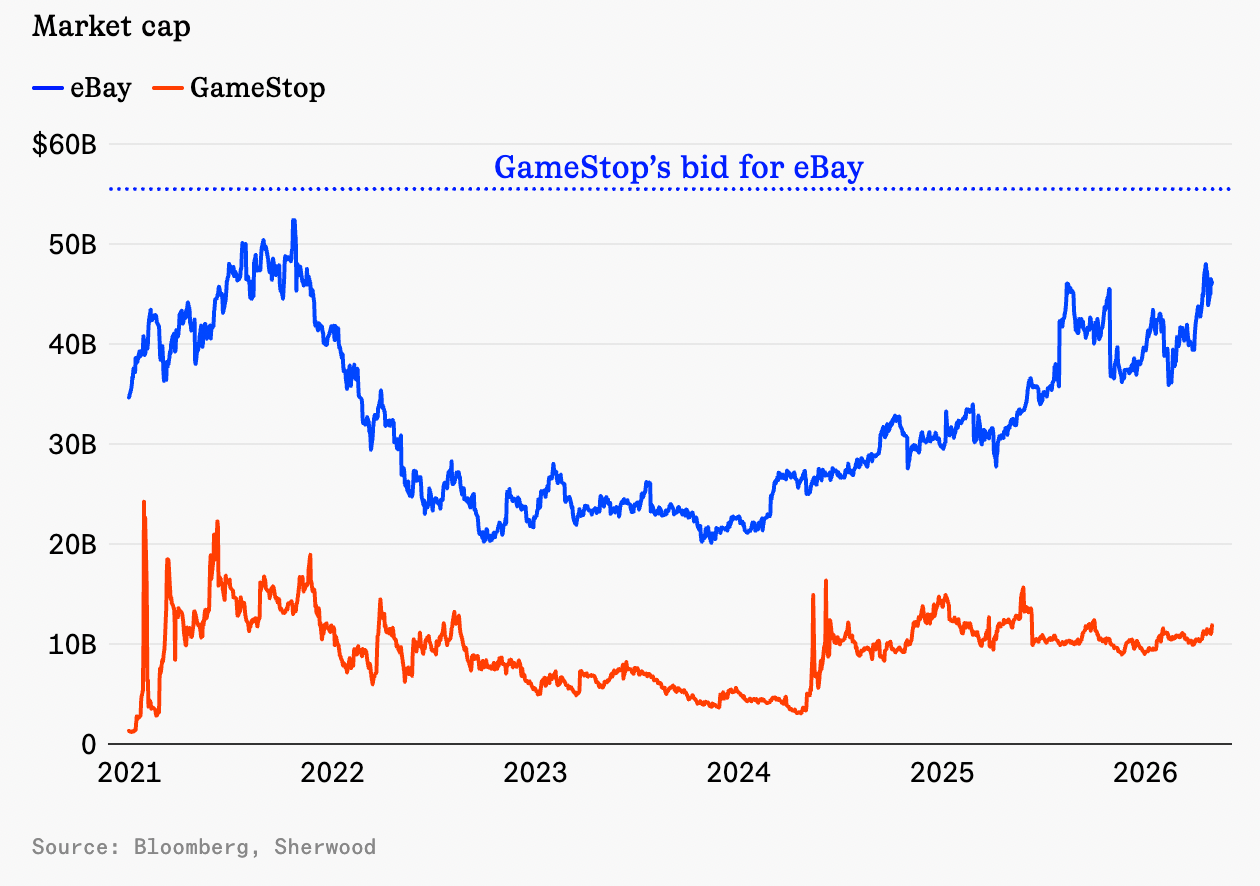
The math is uncomfortable in the best possible way. GameStop is worth roughly $12 billion. The company it wants to buy is worth roughly $46 billion. The financing required — a “highly confident letter” from TD Securities for up to $20 billion — is larger than GameStop itself. About a third of the cash comes from GameStop’s own balance sheet. The rest is borrowed conviction.
Cohen told the Wall Street Journal he is “more qualified than anyone” to run eBay — pointing to his time building Chewy into a pet retail giant before selling it for $3.35 billion at 33 years old.
He also said he’s ready to go to war with shareholders if eBay says no. A proxy battle. Full send.
To be fair — Cohen has earned some audacity. He turned GameStop from a dying mall retailer into a cash-generating machine through brutal expense cuts and discipline. The meme energy got him in the door. The balance sheet kept him there.
But eBay isn’t a turnaround story. It’s a slow bleed that’s been losing ground to Amazon, Etsy, and StockX for a decade.
Great brand. Rough economics. Sound familiar?
SPONSOR BREAK presented by BehindTheMarkets*
Companies are already delaying their IPOs. Why?
Because the SpaceX offering is expected to absorb nearly all the capital in the market.
Bloomberg reported the shift. Citigroup just joined the underwriting team.
The raise could hit $50 billion. But the smart money isn’t just buying the IPO.
They’re positioning into the one chokepoint supplier this $1.75 trillion empire depends on to stay online.
Most investors will see it after the move.
The Guy Who Pressed Sell

Michael Burry — the guy who bet against the entire housing market in 2008 and won — posted three words about the deal on X:
“Makes perfect sense.”
Everyone assumed Burry was bullish.
But he was not bullish.
Burry then published a full piece dripping with sarcasm — and announced he’s selling his GameStop position this week. Here’s what he actually thinks:
Burry, unfiltered
“Neither does this seem revolutionary or ground-breaking in nature. More dilution, or more debt — really, the capital markets strategy here could not be more pedestrian.”
“If GameStop wants to dominate collectibles and used goods with billions of interest expense and all manner of covenants restricting its movements, it will not be breaking new ground. It will be trotting in well-worn ruts on the road to capitalist Hell.”
“Wall Street does indeed mistake debt for creativity, and does so constantly.”
And then Burry pulled out Munger’s quote. The exact one we opened with. He used a Munger’s words as a punchline aimed directly at a living one.
→ GameStop fell 8% Monday.
→ eBay jumped 9%.
SPONSOR BREAK presented by OxfordClub*
Only Hours To Go: Elon’s Biggest Move Ever?
After meeting Elon Musk and analyzing months of research…
Former CIA consultant Dr. Mark Skousen believes June 2026 a potential SpaceX IPO announcement could take place.
He found an “access code” that could let you get exposure ahead of it.
Learn how to claim your stake before time runs out.
So what does it all mean?
→ Ryan Cohen is betting his reputation can rescue eBay’s economics.
→ Burry is betting the economics win.
The market right now has one question it cares about: does this have anything to do with AI?
→ If yes, you get a multiple.
→ If no — whether you’re a meme legend or not — you get skepticism.
Cohen says this deal could be “genius or totally, totally foolish.”
Munger would have told him the business gets to decide.
The market, for now, is voting foolish.
Burry is walking out the door.
And somewhere in the gap between a $6 billion buyer and a $55 billion target, the answer is forming.
Don’t forget to to cast your vote 👇
Lesson Of The Day:
Was this email forwarded to you? Don’t miss out on future stories — subscribe using the button below.
Also, help your friends blossom this spring! Share us with them.
💬 We Want To Hear Your Story:
Got a market or stock you want us to analyze next?
Just drop your request in the comments here.
P.S. – If you no longer want to receive occasional emails from us and you want to unsubscribe, click here 👉 “Unsubscribe” . Thank you!
On A Diet…

Picture the most expensive restaurant you’ve ever been to.
Now imagine every major tech company walks in, sits down, and orders everything on the menu. Twice.
→ Google drops $180-190 billion.
→ Meta slaps down $145 billion.
→ Microsoft and Amazon between them are clearing $300 billion.
The total bill for Big Tech’s 2026 AI infrastructure binge is now north of $700 billion — more than the entire GDP of Switzerland, all of it pointed at data centers, chips, and the existential fear of being the one company that didn’t build enough.
Apple looked at the menu, ordered a side salad, and posted record revenue of $111.2 billion.
iPhone revenue up 20% for the second consecutive quarter.
China — the market everyone had circled in red as Apple’s biggest vulnerability — came in at $20.5 billion against expectations of $18.9 billion.
The stock jumped 5% Friday.
And Apple’s capex for the quarter? $1.9 billion. Down 36% from a year ago.
While every other megacap was shoveling coal into the furnace as fast as humanly possible, Apple spent less than it did last year and somehow came out looking like the smartest person in the room.
The diet is working.
Here’s the story ⇩
SPONSOR BREAK presented by OxfordClub*
Trump Admin to Pump $1 Billion into this “Off-the-Radar” AI Stock
The U.S. government pumped more than $1 billion into Intel. The stock popped 128%. It pumped $400 million into MP Materials. The stock popped 200%. It bought 10% of Trilogy Metals. The stock popped 500%. And now, Trump has chosen this AI stock for a $1 billion payday.
The Menu…

Everyone ordered the same thing. More and faster and bigger.
→ Amazon up 77% on capex year over year.
→ Alphabet up 107%.
→ Microsoft up 85%.
The purple line at the bottom didn’t move. That’s Apple. It also had the best week of anyone at the table.
SPONSOR BREAK presented by BehindTheMarket*
Strange Elon Crates Spotted Near the Hoover Dam
Tesla is shipping thousands of strange white crates to critical locations across America.
And Adam O’Dell, the analyst who recommended Palantir before it became the top performer in the S&P 500, has the scoop…
He says they are part of a new “super startup” that has nothing to do with electric vehicles, space, social media, crypto, biotech, robots or AI…
But it could go down as Elon’s greatest ever disruption…
The Buffet Has a Two-Speed Problem
Google and Meta both reported earnings Wednesday. Both beat expectations. Both raised their already enormous capex forecasts.
→ Alphabet up 6%,
→ Meta down nearly 9% — which tells you everything about what Wall Street actually thinks is going on beneath the surface.
Here’s the difference.
1 Google isn’t just spending on AI infrastructure — it’s selling AI infrastructure.
Those tensor processing unit chips it’s been building for internal use?
Google confirmed this week it’s going to start delivering them to outside customers, with Meta reportedly already in line.
Analysts have estimated that business alone could be worth $900 billion. Google Cloud grew 63% last quarter to over $20 billion in revenue. So when Google raises its capex forecast, it has a receipts to show for it.
2 Meta raised its forecast to $145 billion and when Morgan Stanley asked Mark Zuckerberg directly what signposts he’s watching to make sure that spend generates a return, he said something about building experiences for billions of people and monetizing at scale. Which is technically an answer. It’s just not the answer the question was asking for. And then the cherry on top — daily active users across Meta’s apps dipped for the first time since 2019. First time since 2019. While Meta is committing to its biggest infrastructure spend ever.
Google is building the restaurant and charging everyone rent. → Meta is the customer who keeps ordering more food while telling you the bill will sort itself out eventually.
SPONSOR BREAK presented by OxfordClub*
Only Hours To Go: Elon’s Biggest Move Ever?
After meeting Elon Musk and analyzing months of research…
Former CIA consultant Dr. Mark Skousen believes June 2026 a potential SpaceX IPO announcement could take place.
He found an “access code” that could let you get exposure ahead of it.
Learn how to claim your stake before time runs out.
The Most Expensive Family Dinner in History
Tesla’s amended annual filing dropped this week and it is genuinely one of the more fascinating documents in recent corporate history if you’re into the kind of thing where one billionaire’s companies spend half a billion dollars buying from each other.
Here’s the web.
→ xAI paid Tesla $430 million last year, mostly for Megapack battery storage.
→ SpaceX spent $143 million on Tesla products — a big chunk of that almost certainly the $100 million worth of Cybertrucks it purchased in Q4, which works out to roughly one in five Cybertrucks registered in the US that quarter being bought by Musk’s own rocket company.
→ Tesla then invested $2 billion in xAI, which merged with SpaceX, which means Tesla now owns a piece of SpaceX.
! The company that sold batteries to the AI startup that merged with the rocket company that bought the trucks now has equity in all of it

source: sherwood
Meanwhile the Tesla Semi finally rolled off the high-volume production line in Sparks, Nevada — about nine years after Elon Musk first unveiled it, with production targets missed in 2019, 2020, and several years after that. It’ll run you $260,000 for standard range or $290,000 for long range. Tesla is targeting 50,000 units per year. Frito-Lay has been testing it since 2022 and presumably has opinions.
Tesla’s CFO also confirmed capex will exceed $25 billion this year, pushing free cash flow negative for the rest of 2026.
The stock dropped 7% last week, recovered about 2% this week, and Elon Musk’s disclosed 2025 compensation came in at $158 billion — entirely in equity, none of it actually realized, all contingent on targets that weren’t hit, so his actual realized pay was zero.
The gap between $158 billion and zero is doing a lot of work in that sentence.
So What Does the Side Salad Mean?

Apple has real problems ahead — margin pressure from the global memory shortage, a CEO transition from Tim Cook to John Ternus in September, a foldable iPhone in the pipeline, and an AI strategy that is currently best described as “we’re working on it.” WWDC on June 8 is when that story either starts making sense or gets more complicated.
But here’s what this week actually showed: you can skip the $700 billion infrastructure arms race, partner with Google for your AI, spend 36% less than you did last year, and still post record revenue while your stock tests all-time highs.
Apple isn’t winning because of its AI strategy.
It’s winning despite not having one yet.
That’s either the most impressive thing in tech right now, or the calm before something gets very awkward in June.
Either way, the side salad is still on the table.
Don’t forget to to cast your vote 👇
Lesson Of The Day:

Was this email forwarded to you? Don’t miss out on future stories — subscribe using the button below.
Also, help your friends blossom this spring! Share us with them.
💬 We Want To Hear Your Story:
Got a market or stock you want us to analyze next?
Just drop your request in the comments here.
P.S. – If you no longer want to receive occasional emails from us and you want to unsubscribe, click here 👉 “Unsubscribe” . Thank you!


