


Don’t forget to cast your vote 👇
Most days, the dollar sits quietly behind everything you buy, sell, invest, or save. It prices your coffee, your portfolio, your vacation, your oil, your gold — and then politely stays out of the spotlight.
Stocks move.
Crypto swings.
Commodities spike.
The dollar usually just… exists.
Which is why it’s worth paying attention when the dollar suddenly becomes the headline.
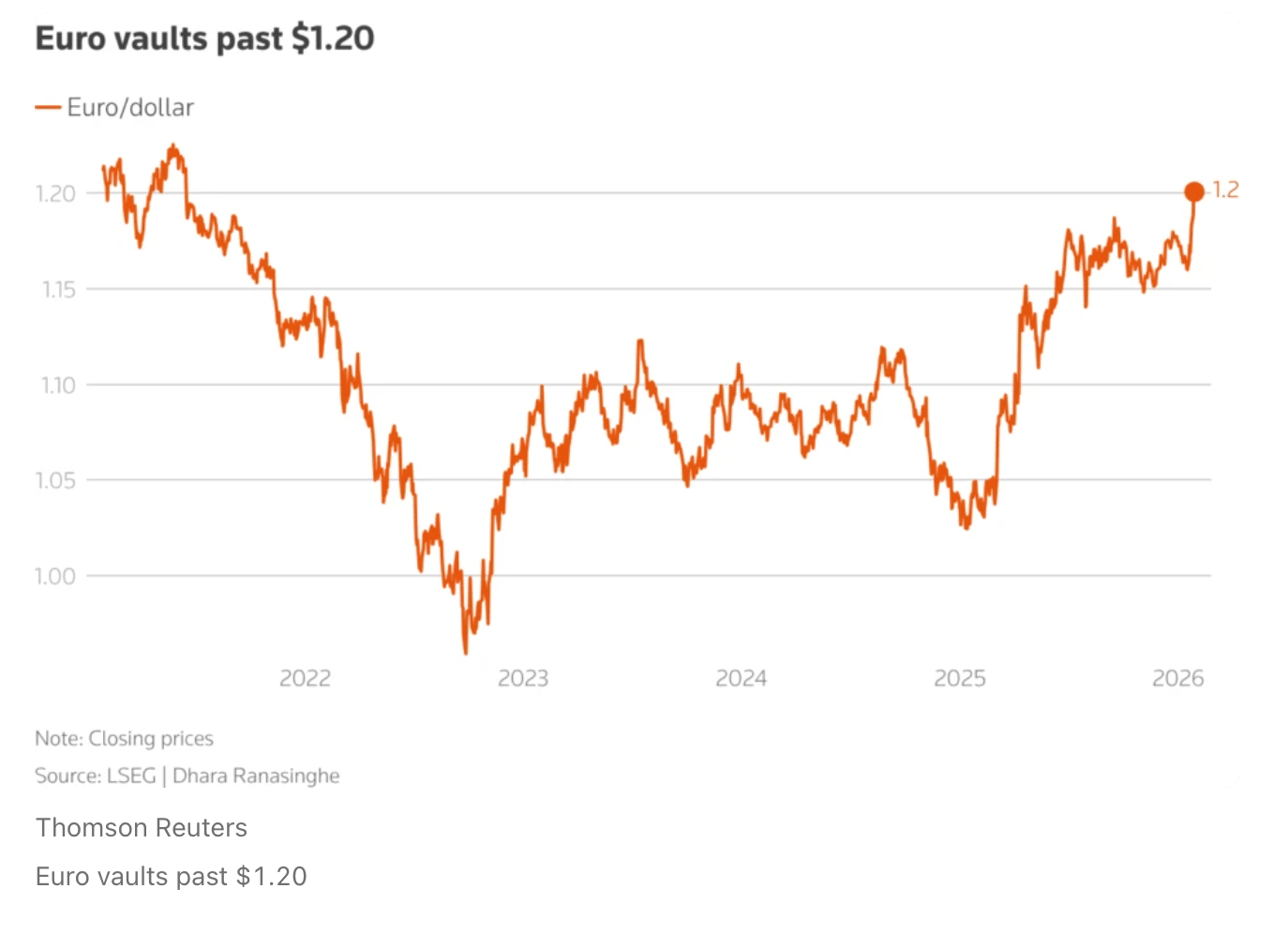
This week, the greenback dropped about 1.3% ▼ in a single session — its sharpest daily slide in months — and briefly touched levels not seen since early 2022. Over the past year, it’s now down roughly 10%.

The spark wasn’t a data miss or a central bank surprise. It came from a simple comment.
When asked whether the currency had fallen too far, President Trump said he was comfortable with the move and described a weaker dollar as “great.”
Markets didn’t debate the nuance.
They reacted to the signal.
Weak Dollar Isn’t Always Bad News
Everyone likes a good deal.
You feel it when your favorite coffee suddenly costs a dollar less.
You feel it when flights drop overnight.
You feel it when something you’ve been putting off suddenly feels easier to afford.
Cheaper feels like winning.
But sometimes “cheaper” just means the bill shows up somewhere else.
That same logic quietly applies to currencies — even if most of us never think about it that way.
A weaker dollar isn’t automatically bad news.
In fact, the early effects often look constructive.
→ U.S. products suddenly feel cheaper to buyers overseas, so exports sell faster.
→ Companies that earn money abroad see those profits stretch a little further when they come home.
→ Tourism and travel get a quiet boost as price advantages shift.
Governments sometimes tolerate — or even quietly welcome — a softer currency because a softer dollar + modest inflation, slowly reduces the real burden of fixed debt. When trillions of dollars are owed, even small shifts in purchasing power matter.
And markets tend to enjoy this phase.
Until the trade-offs start surfacing.
→ Imports get more expensive.
→ Inflation pressure creeps in.
→ Investors begin paying closer attention to where their capital actually wants to sit.
The benefits arrive quickly. The consequences tend to move more slowly.
And that’s the uncomfortable part.
Which sets up the real question:
When the dollar weakens… do the pros actually outweigh the cons? 👇
You don’t have to guess.
You can watch where the money is going.
As the dollar slid, capital started repositioning almost immediately.
Gold ( ▲ 3.68% ) climbed to fresh record highs above $5,300, extending a rally that’s been quietly building in the background. The euro ▲ ( 1 EUR ≈ $1.20 USD ) pushed into territory it hasn’t seen in years. The Swiss franc ▲ ( 1 CHF ≈ $1.30 USD ) picked up demand as investors leaned toward familiar safe havens. Even the yen caught a bid as policy chatter crept back into the conversation.
Nothing dramatic on its own.
But together, it tells a simple story: money started exploring alternatives.
Some strategists have framed this less as a technical currency move and more as a confidence shift. When leadership signals comfort with a weakening currency, the psychological backstop under the dollar naturally feels thinner. That doesn’t trigger panic. It triggers optionality.
Capital likes options.
Crypto hasn’t joined the party yet in a meaningful way, especially compared with gold. But several macro investors have noted that if confidence erosion continues — and if traditional hedges become crowded — alternative reserve assets like bitcoin may eventually start catching more of that flow.
The point is that the race has already started.
Which brings us back to the trade-off.
SPONSOR BREAK presented by BanyanHill*
President Trump Just Privatized The U.S. Dollar
A controversial new law (S.1582) just gave a small group of private companies legal authority to create a new form of government-authorized money.
Today, I can reveal how to use this new money… why it’s set to make early investors’ fortunes, and what to do before the wealth transfer begins on February 17 if you want to profit.
Go here for details now — while you still have time to position yourself.
What Keeps the Dollar Trend Up?
Currency trends don’t reverse just because prices feel stretched.
They reverse when the reasons for owning them start to shift.
→ As long as growth differentials favor the U.S., capital tends to stay home.
→ As long as real yields remain attractive, global money tolerates volatility.
→ As long as policymakers signal stability, confidence holds.
As long as those advantages remain in place, capital tends to stay comfortable — even if prices wobble along the way.
That’s why Treasury Secretary Scott Bessent emphasized this week that the U.S. continues to operate under a strong-dollar framework grounded in sound fundamentals. In his view, healthy policies ultimately attract capital, regardless of short-term market noise.
Markets constantly recalibrate around growth expectations, yield differences, and global opportunity. That process is less about drama and more about quiet adjustment.
Most currency trends evolve the same way.
Gradually. Rationally. Boringly.
Until something genuinely changes.
What Would Naturally Shift the Momentum
For the dollar’s direction to meaningfully adjust, markets would typically look for changes in a few familiar drivers:
→ How U.S. growth compares with the rest of the world
→ Whether dollar assets continue offering attractive real returns
→ How predictable policy remains over time
As these inputs evolve, capital allocation naturally adapts.
This is a healthy and ongoing process within global markets — not a signal of instability.
SPONSOR BREAK presented by BehindtheMarkets*
A U.S. “birthright” claim worth trillions – activated quietly
A tiny government task force working out of a strip mall just finished a 20-year mission.
And with almost no media coverage, they confirmed one of the largest U.S. territorial expansions in modern history…
A resource claim worth an estimated $500 trillion.
Thanks to sovereign U.S. law, this isn’t just a national asset.
It’s an American birthright.
That means every citizen now has the legal right to stake a claim…
But very few even know the opportunity exists.
If you want to see how you can get in line for your portion of this record-breaking windfall…
I’ve assembled everything you need to see inside a new, time-sensitive briefing:
Get all the details here – while the claim window remains open.
A Fresh Signal From the Fed
Another piece of the puzzle landed today.
The Federal Reserve left interest rates unchanged at its first meeting of 2026, keeping the benchmark range at 3.5%–3.75% after three straight cuts last year. Two officials wanted another quarter-point cut, but the broader group chose to stay patient.

At the same time, policymakers quietly upgraded their view of the economy from “moderate” to “solid,” pointing to stronger growth momentum, while still acknowledging that inflation hasn’t fully cooled.
Translation: the Fed isn’t hitting the gas — and it isn’t slamming the brakes either.
Rates aren’t being rushed lower. Growth still looks healthy. Inflation is behaving… but not perfectly. And the committee keeps emphasizing that decisions will follow the data, not headlines.
That steady posture helps explain why Treasury officials continue to sound comfortable with a fundamentals-driven dollar framework, even as markets digest shifting flows and political noise.
It doesn’t magically settle the dollar debate.
But it does reinforce something important:
This environment is evolving through steady calibration — not sudden crisis.
So… do the pros actually outweigh the cons?
In the short term — yes, they often do.
A softer dollar can support exports, lift multinational earnings, encourage tourism, and quietly reduce the real burden of debt. Growth feels steadier. Financial conditions stay supportive. Markets tend to stay constructive.
That’s why policymakers don’t always rush to fight modest currency weakness.
In the medium to long term — not usually.
If a weaker currency persists, inflation pressure becomes harder to ignore. Purchasing power erodes. Foreign capital grows more selective. Funding large deficits becomes more sensitive to confidence.
The same forces that help early can slowly become friction later.
A weaker dollar can buy time.
It doesn’t change the underlying math forever.
The real advantage for investors isn’t predicting the next headline move.
It’s recognizing when a short-term tailwind starts turning into a longer-term trade-off.
Lesson of the Day

💬 We Want To Hear Your Story:
Got a market or stock you want us to analyze next?
Just drop your request in the comments here.
Was this email forwarded to you? Don’t miss out on future stories — subscribe to the TradingLessons and get our daily market breakdown delivered straight to your inbox.
❗ P.S. – If you no longer want to receive occasional emails from us and you want to unsubscribe, click here 👉 “Unsubscribe” . Thank you!


