


Getting flashbacks?
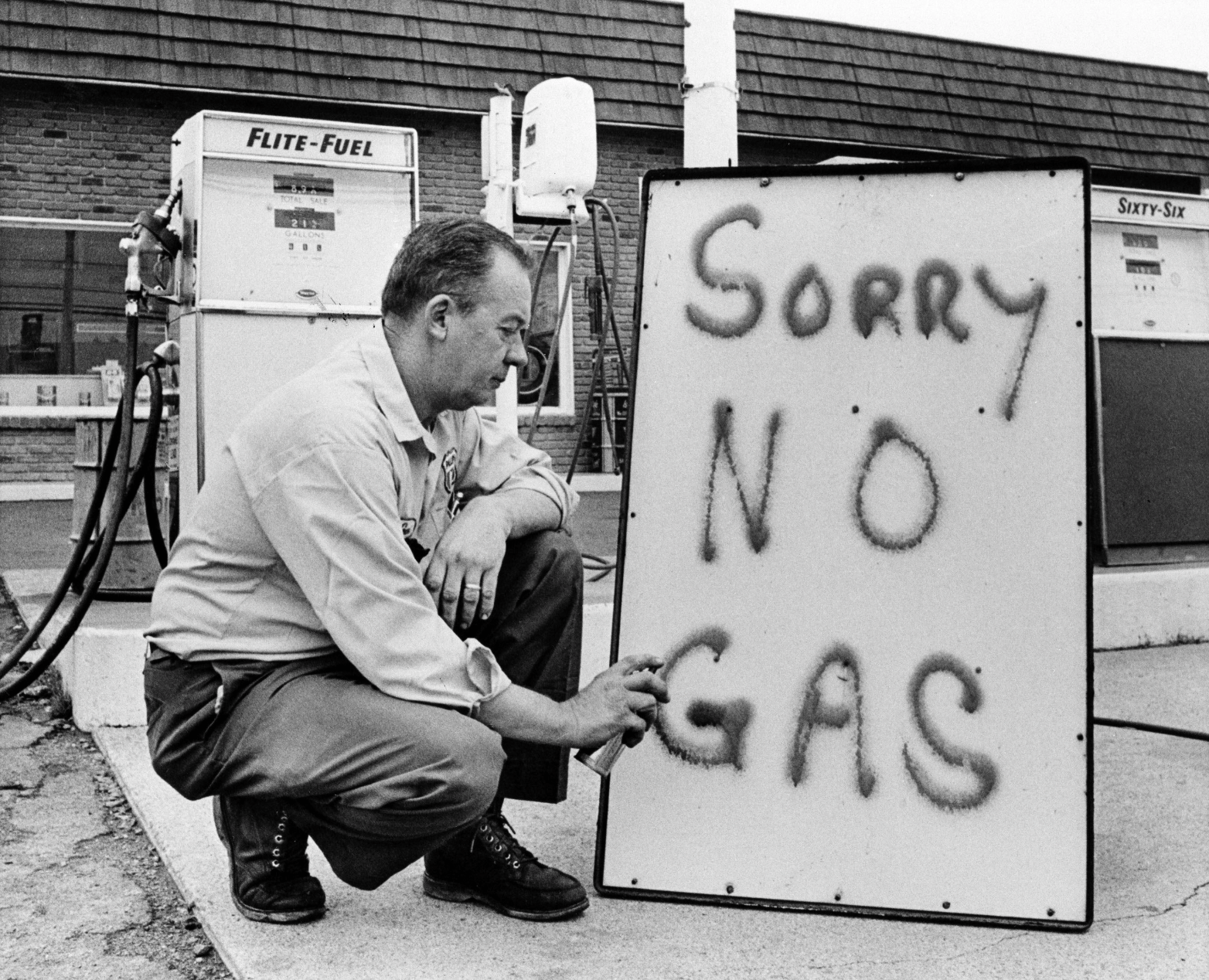
In 1973, King Faisal of Saudi Arabia made a decision that broke the global economy.
Not with bombs. Not with armies.
With a pipeline valve.
He shut off oil exports to the West during the Yom Kippur War – and within weeks, gas lines stretched around city blocks, Nixon capped the national speed limit at 55 mph, and Americans were carpooling for the first time in their lives.
The price of oil quadrupled in four months.
The inflation it triggered lasted a decade.
Here’s the thing nobody talks about: the companies that already had energy locked up didn’t just survive. They got rich.
Because scarcity has a very simple economic logic.
The people who already own the thing everyone suddenly needs… win.
Fast forward 53 years. The Strait of Hormuz – the 21-mile chokepoint that carries 20% of the world’s oil – just closed.
And that same logic is playing out again. In real time.
Here’s the story ⇩
Day Three
That’s where we are with the Hormuz crisis.
Three days in, and oil is marching toward $100 a barrel like it has somewhere to be.
(It does. It’s going to $100.)
The broader market is already doing the math on what that means.
→ S&P 500 › ▼ 0.68%
→ Dow Jones › ▼ ~1%
But here’s what’s interesting.
While almost everything sold off today, one corner of the market quietly had a very good Wednesday.
→ VLO ( ▲ 1.06% ) (Valero Energy)
Refiners. The unsexy, industrial, nobody-talks-about-them-at-dinner-parties refiners.
Up.
Because when supply gets choked off, the companies that already have the infrastructure, the inventory, and the contracts don’t scramble. They just raise their prices and collect the premium.
It’s the 1973 playbook. Almost line for line.
SPONSOR BREAK presented by BehindTheMarkets*
The 1979 Iran crisis helped ignite gold’s greatest bull run in history.
Gold set 54 all-time highs that year.
The mining stocks?
They exploded 1,000%… 3,000%… even 13,000%.
History doesn’t always repeat, but it often rhymes.
One company, right now, is sitting on more gold than the national reserves of most G7 nations…
And it’s still trading at a 99% discount to what it’s actually worth.
The Number That Actually Matters
Everyone’s watching $100 oil (crude) like it’s a scoreboard.
But $100 isn’t just a round number.
It’s the level where consumer behavior historically breaks.
Gas hits $4 (national average) a gallon?
→ People download carpooling apps. (Yes, again.)
→ Airline bookings slow.
→ Road trips get reconsidered.
→ And companies that pass costs to consumers — restaurants, retailers, anyone with thin margins — start getting squeezed in ways that show up in earnings three months later.
We’re not at $4 gas yet.
But the market is already pricing in the possibility. Which is why the S&P fell today without a single bad earnings report.
Just vibes. Expensive, oil-soaked vibes.
Then The Second Punch Landed…

source: Orlando Sentinel
The PPI showed up and made everything worse.
As if the Hormuz crisis wasn’t enough to deal with.
February’s Producer Price Index — which measures what businesses pay before they pass costs to you — came in at +0.7%.
The expectation was 0.4%.
(The market does not like surprises. Especially inflationary ones.)
And the part that really stung: core PPI, which strips out food and energy, also ran hot.
Meaning this isn’t just an oil story. The inflation is broader. It was already building before a single tanker got rerouted.
Hot inflation is not a perfect future.
When input costs rise faster than pricing power, margins compress.
Chipotle can only raise burrito prices so many times before customers start making rice at home. (It happens. It’s called demand destruction and it is deeply unglamorous.)
SPONSOR BREAK presented by TheOxfordClub*
Get “Backdoor Access” BEFORE the SpaceX IPO
When SpaceX goes public, it could hit a $1.5 TRILLION valuation – that would be 3,000 times bigger than Amazon’s IPO.
Most investors will be locked out until AFTER the big announcement.
But I’ve discovered a “backdoor” that lets you grab a pre-IPO stake in SpaceX right now.
I’m revealing the ticker for free.
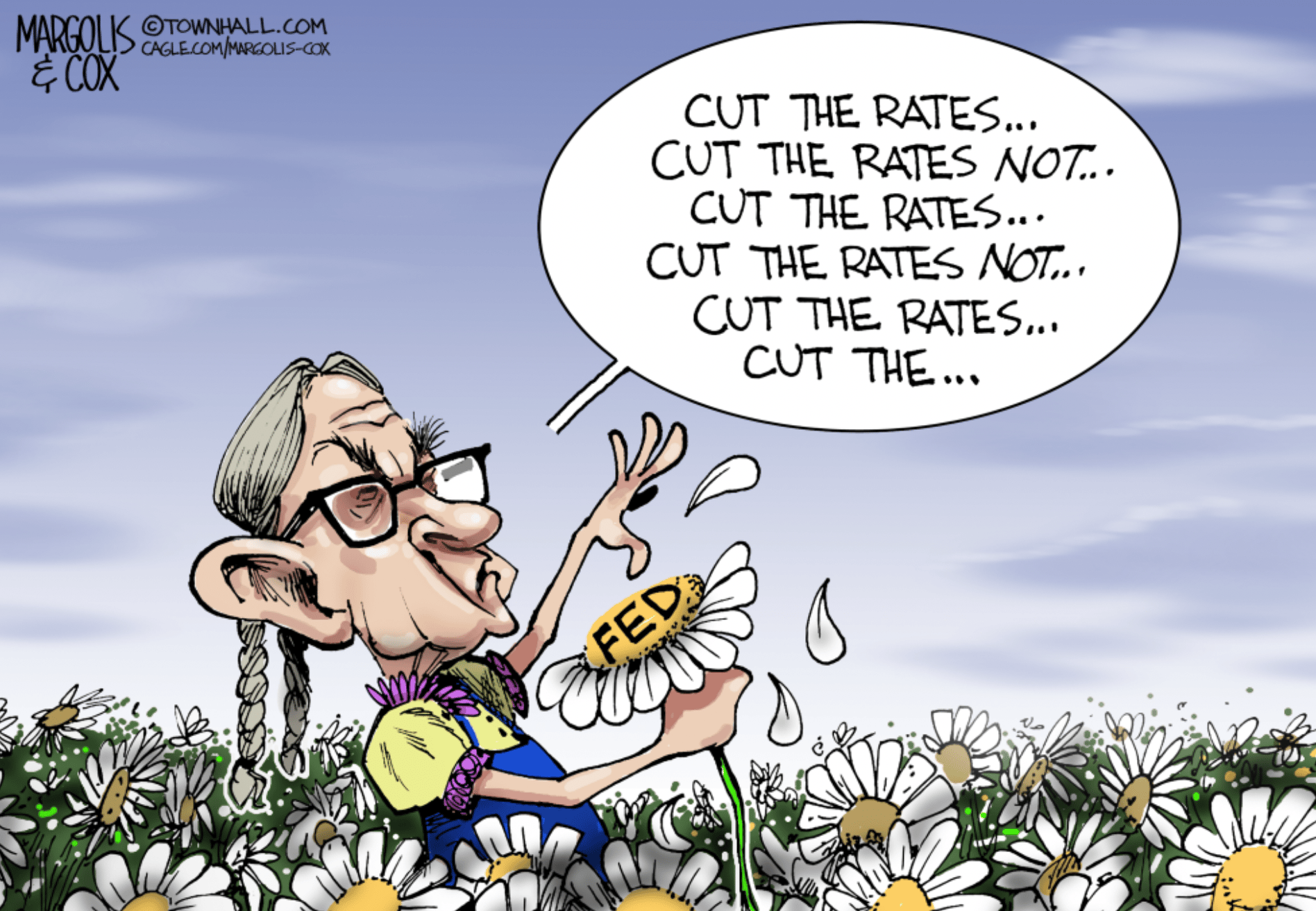
Completely Powerless.
source: Margolis & Cox, Courtesy CagleCartoons.com
And then, right in the middle of all of this, Jerome Powell held a press conference.
The decision: hold rates at 3.5%–3.75%.
No cut. No shock. No drama.
Except there is quite a bit of drama, actually.
Because here’s the Fed’s problem in one sentence: you cannot fix a geopolitical oil shock with an interest rate.
Raising rates doesn’t reopen the Strait of Hormuz. Cutting rates doesn’t bring inflation down when the world’s energy chokepoint is closed.
The Fed is essentially a very powerful institution that is completely powerless over the thing currently driving prices.
(They would like you not to focus on that.)
So instead, they updated their forecasts.
→ Headline inflation revised up to 2.7%.
→ Core inflation revised up to 2.7%.
→ Growth nudged slightly higher.
And the dot plot — the Fed’s internal forecast of where rates are going — still shows one cut in 2026.
Barely.
The room is split almost perfectly in half:
→ 7 officials see zero cuts this year
→ 7 officials see one cut → The rest are spread across two, three, and four cuts
One very optimistic official sees four cuts coming.
(That person is having a fundamentally different 2026 than their colleagues.)
Before the Iran war started, markets had a full rate cut priced in by July.
Today? A full cut isn’t priced in for all of 2026.
That’s how fast the calculus flipped.
The Subplot Nobody Can Ignore
This was Powell’s second-to-last meeting as Fed Chair.
President Trump has been calling for rate cuts publicly. (He said this week that “a third grader would cut rates now.” A sentence that will age in one of two very different directions.)
His nominee to replace Powell — Kevin Warsh — is waiting for Senate confirmation. One Republican senator has vowed to block it until a DOJ criminal probe into Powell is dropped. A federal judge just threw out the subpoenas behind that probe. The DOJ is appealing.
It’s a lot.
None of it changes monetary policy today. But it is the background noise surrounding the institution currently making the most consequential economic decisions of the year.
SPONSOR BREAK presented by Paradigm*
Have you heard the news?
Elon Musk’s company Starlink is preparing to announce their IPO as soon as March 26th!
According to Quartz, “Elon Musk’s Starlink IPO may lift off any day now”
And for the first time ever, you have the rare chance to see how to profit BEFORE the IPO takes place.
Click here now for the time-sensitive details.
So What Do You Do With All Of This?

Two scenarios. Pick your world.
World A: The Strait reopens in days. Oil pulls back. Inflation fears fade. The Fed finds room to cut in the back half of the year. Growth stocks recover. The market forgets this happened by Memorial Day.
World B: The closure drags on. Oil stays elevated. Core inflation stays stubborn. The Fed stays frozen. You get slower growth and higher prices simultaneously — which is the economic combination nobody has a clean solution for.
History gives you one data point to sit with.
The 1973 embargo lasted five months.
The inflation it triggered lasted ten years.
Nobody is calling for that outcome today.
But the market is quietly starting to ask whether it should start asking the question.
And that question alone is worth more than any rate cut.
Don’t forget to to cast your vote 👇
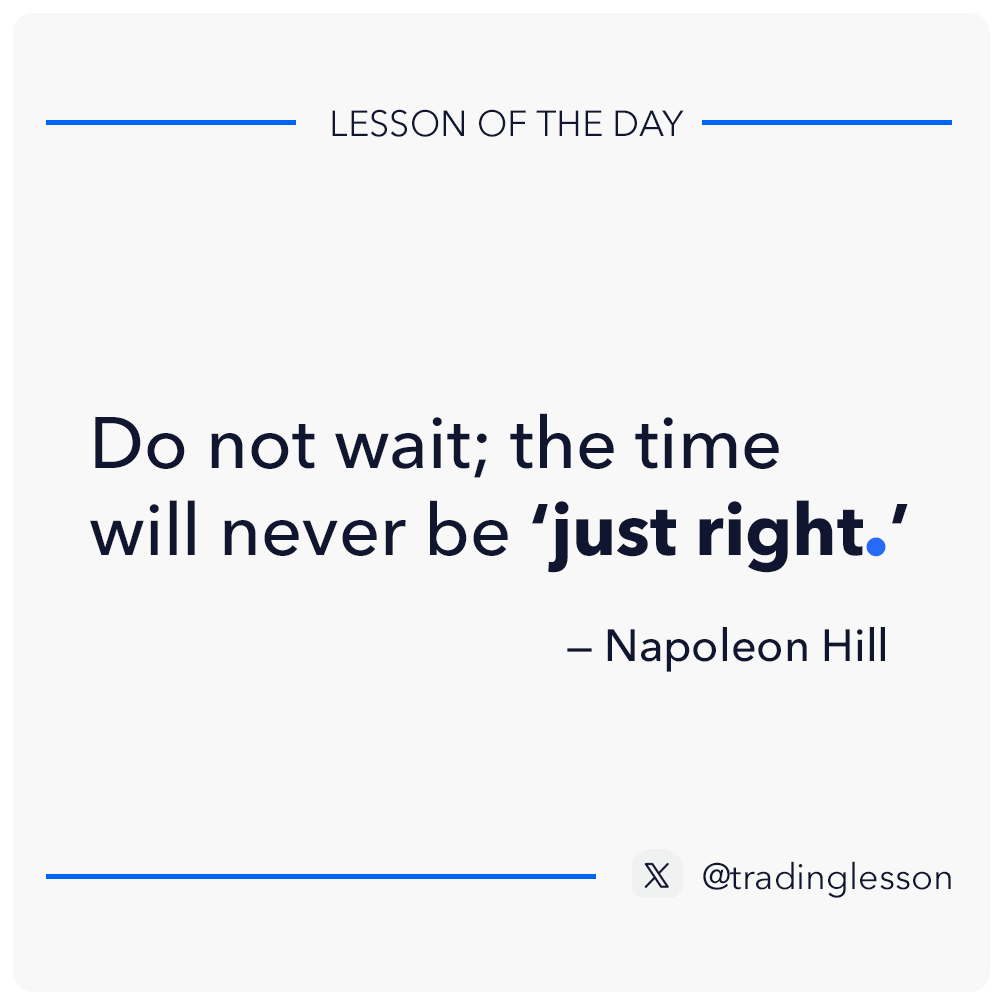
Lesson Of The Day:
Was this email forwarded to you? Don’t miss out on future stories — subscribe using the button below.
Also, help your friends blossom this spring! Share us with them.
💬 We Want To Hear Your Story:
Got a market or stock you want us to analyze next?
Just drop your request in the comments here.
❗ P.S. – If you no longer want to receive occasional emails from us and you want to unsubscribe, click here 👉 “Unsubscribe” . Thank you!


