


Don’t forget to to cast your vote 👇

Inflation rarely fades in a straight line.
Economists often describe the process as uneven. Prices cool for a period of time, the pressure inside the system begins to ease, and markets gradually grow comfortable that the worst is behind them.
Then something shifts.
For much of the past year, investors believed the U.S. economy was moving through that cooling phase. Inflation had fallen sharply from its pandemic peak, Treasury yields drifted lower, and expectations slowly formed that the Federal Reserve might eventually have room to begin cutting interest rates.
The process was gradual, but the direction looked clear.
That narrative started to wobble this week.
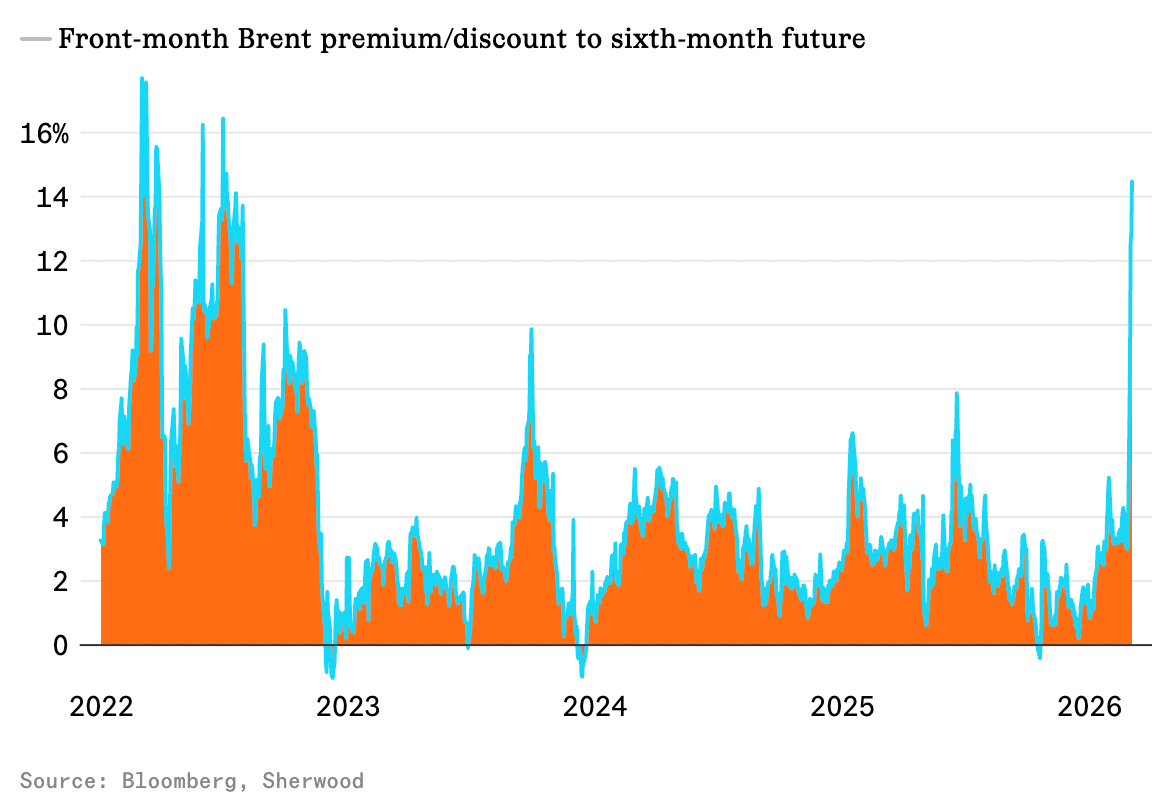
Since tensions escalated in the Middle East, crude oil prices have jumped roughly 14–15%, forcing markets to reconsider how durable the recent progress on inflation might actually be.
Because energy has a unique role in the global economy.
Unlike most commodities, oil doesn’t simply move through supply chains — it powers them. Ships burn it, trucks rely on it, airplanes consume enormous amounts of it, and the cost of moving goods across the world rises with it.
When oil climbs quickly, the effect rarely stays confined to the energy market.
And that’s exactly why the Federal Reserve is watching this move so closely.
Here’s the story ⇩
SPONSOR BREAK presented by OxfordClub*
Strange New Wonder Metal Outperforms Silicon Up to 100X
Nvidia just partnered with the tiny company that holds 250 patents.
Here’s why it could become the most important stock in the world.
Oil Is Inflation’s Fastest Shortcut
The concern isn’t just the price of oil itself.
It’s how quickly that price spreads through the economy.
Goldman Sachs estimates that a 10% rise in oil prices could increase headline CPI by roughly 0.28 percentage points.

That may sound small, but when inflation is already hovering near 3%, even modest pressure makes it harder for policymakers to push prices toward their 2% target.
In more extreme scenarios, the effects can become much larger.
Apollo Global economist Torsten Sløk estimates that if crude prices were to jump $50 per barrel, inflation could temporarily rise by around one percentage point above baseline levels.
! For central banks, that’s the nightmare scenario: inflation that begins to move higher again just as policy makers were preparing to ease.
SPONSOR BREAK presented by BehindtheMarket*
A U.S. “birthright” claim worth trillions – activated quietly
A tiny government task force working out of a strip mall just finished a 20-year mission.
And with almost no media coverage, they confirmed one of the largest U.S. territorial expansions in modern history…
A resource claim worth an estimated $500 trillion.
Thanks to sovereign U.S. law, this isn’t just a national asset.
It’s an American birthright.
That means every citizen now has the legal right to stake a claim…
But very few even know the opportunity exists.
If you want to see how you can get in line for your portion of this record-breaking windfall…
I’ve assembled everything you need to see inside a new, time-sensitive briefing:
Get all the details here – while the claim window remains open.
The Rate Cut Problem
Financial markets have started responding to that possibility.
Treasury yields moved higher this week as traders reduced expectations for near-term rate cuts. Measures of inflation expectations have also begun climbing, with the two-year breakeven rate rising toward roughly 2.9% from around 2.3% earlier this year.
Fed officials are acknowledging the uncertainty.
Minneapolis Fed President Neel Kashkari said geopolitical developments mean policymakers need “a lot more data” before committing to rate cuts.
New York Fed President John Williams echoed that view, noting that energy prices could influence the near-term inflation outlook depending on how persistent they become.
For now, traders still expect the Fed to keep rates unchanged at the upcoming meeting.
But the path beyond that has become less certain.
The Real Risk
Historically, central banks often look past temporary energy shocks.
If oil spikes briefly and then retreats, policymakers typically focus on underlying inflation trends.
The risk emerges when energy prices remain elevated long enough to influence expectations.
If consumers begin assuming gasoline, transportation, and food costs will keep rising, those expectations can feed into wage negotiations and business pricing decisions.
At that point, inflation stops behaving like a temporary shock.
It becomes self-reinforcing.
And when that happens, central banks usually become far more cautious about easing policy.
SPONSOR BREAK presented by OxfordClub*
How Mitt Romney Turned $450K Into Up to $100 Million (Tax-Free)
It wasn’t stocks. It wasn’t real estate. It was a little-known investment vehicle that turned Mitt Romney’s $450,000 into as much as $100 million and Peter Thiel used to turn $2,000 into $5 billion within two decades. Now, thanks to a new executive order, regular Americans can access the same type of investment.
Get more details here >>
Where the Market Felt It First
Higher oil prices rarely move markets evenly.
Some industries benefit almost immediately.
Others feel the pressure within hours.
And as crude climbed to its highest level since early 2025, energy stocks quickly became one of the few bright spots in the market.
U.S. oil and gas producers led the advance:
→ APA Corporation APA ( ▲ 4.12% ) ▲ $32.26
→ Devon Energy DVN ( ▲ 2.37% ) ▲ $44.52
→ Coterra Energy CTRA ( ▲ 1.96% ) ▲ $31.15
Natural-gas exposure also helped lift producers after Qatar temporarily halted LNG liquefaction, sending global gas prices higher.
Refiners joined the move as well.
Higher crude prices can squeeze some parts of the economy, but they often boost refining margins and fuel marketing.
→ Valero Energy VLO ( ▲ 1.08% ) ▲ $226.24
→ Phillips 66 PSX ( ▲ 1.04% ) ▲ $166.44 (+1.06%)
Meanwhile, industries that depend heavily on fuel costs moved in the opposite direction.
Airlines, which treat jet fuel as one of their largest operating expenses, fell sharply:
→ Allegiant Travel ALGT ( ▼ 8.64% ) ▼ $84.13
→ Frontier Group Holdings ULCC ( ▼ 5.13% ) ▼ $3.70
→ Delta Air Lines DAL ( ▼ 3.95% ) ▼ $61.32
→ United Airlines UAL ( ▼ 5.03% ) ▼ $95.29
→ American Airlines AAL ( ▼ 5.38% ) ▼ $11.77
Retailers also struggled as investors considered the consumer impact.
Higher gasoline prices often act like a tax on household spending, leaving less income for discretionary purchases.
→ Walmart WMT ( ▼ 3.53% ) ▼ $123.00
→ Dollar General DG ( ▼ 3.27% ) ▼ $146.15
To Sum Up
Geopolitical headlines often dominate the news cycle.
But for markets, the real signal usually appears somewhere else.
This time, it’s in energy.
When oil rises sharply:
→ Inflation expectations move higher
→ Bond yields climb
→ Rate cuts get pushed further into the future
Which means the most important chart for the Federal Reserve right now may not be the S&P 500.
It’s the price of crude.
Lesson of the Day

💬 We Want To Hear Your Story:
Got a market or stock you want us to analyze next?
Just drop your request in the comments here.
Was this email forwarded to you? Don’t miss out on future stories — subscribe to the TradingLessons and get our daily market breakdown delivered straight to your inbox.
❗ P.S. – If you no longer want to receive occasional emails from us and you want to unsubscribe, click here 👉 “Unsubscribe” . Thank you!


