


Don’t forget to cast your vote 👇
Gold and silver have been everywhere last week.
At this point, even my dog probably has a view on gold.
So before we all start seeing bullion in our dreams, let’s give the metals a quick timeout today.
We’re turning our head to two other stories that are just as interesting.
Enjoy reading.
SpaceX Just Ate xAI

This didn’t just get closer to a deal. It got closer to a public company.
Bloomberg first said SpaceX and xAI were in “advanced talks.”
Now there’s an internal memo saying they’ve merged — with a target valuation around $1.25–$1.5 trillion.
On the surface, this looks like Elon Musk combining two of his companies.
Underneath, it looks like him designing a story the public markets can actually price.
1 Here’s why.
SpaceX alone is an extraordinary business — rockets, satellites, Starlink, manufacturing, launch contracts — but it’s still a capital-intensive, long-cycle company. Great technology. Harder multiples.
xAI, on the other hand, is pure future optionality.
High-margin. High-growth. Very “marketable” to public investors.
Put them together, and you don’t just get a space company.
You get a space + AI platform.
Rockets + satellites + compute + data + distribution (X). That’s a stack.
From an IPO perspective, that matters.
Public markets tend to pay up for:
→ Platforms
→ Ecosystems
→ Vertical integration
→ AI exposure
→ Scarce assets with network effects
A standalone SpaceX IPO would have been massive.
A combined SpaceX/xAI IPO is designed to be legendary.
2 In fact, the timeline now looks real.
SpaceX is reportedly targeting a mid-June IPO, possibly around June 9 — when Jupiter and Venus align in the night sky. (Of course Musk would time a $1.5 trillion IPO to a cosmic event.)
The company is aiming to raise up to $50 billion, which would make this the largest IPO by capital raised in history. At a ~$1.5 trillion valuation, it would likely be the second-most valuable IPO ever, behind only Saudi Aramco.
OpenAI might try to rival it this year — but SpaceX would still be the heavyweight.
And retail investors are already positioning.
A private fund that holds SpaceX shares has seen inflows surge more than 200% since IPO rumors began. People are already trying to get in before this thing ever hits the public tape.
For Musk personally, the stakes are staggering.
He owns roughly 42% of SpaceX — which could be worth $600+ billion at the target valuation. That’s more than triple the value of his current Tesla stake.
3 There’s another signal buried in the reporting though: Tesla fading to the background.
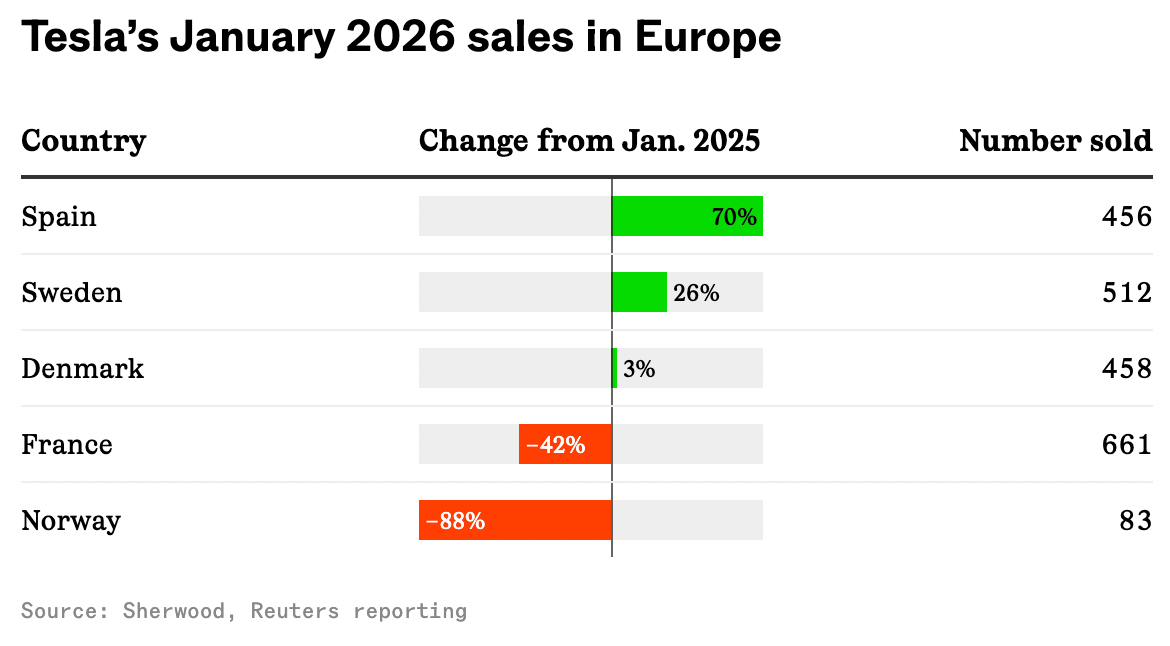
Earlier leaks floated Tesla as part of the tie-up.
Now, in the latest stories that move the deal forward, Tesla is barely mentioned.
Translation:
Musk isn’t trying to blur SpaceX with Tesla — he’s trying to separate their destinies.
1) SpaceX becomes the space + AI powerhouse.
2)Tesla stays the robotics, autonomy, and energy company.
Two different public-market stories. Cleaner. Easier to value.
Then there’s the “data centers in space” angle.
Most people read that as sci-fi. Markets will read it as capex with a moonshot narrative.
If SpaceX can even partially pull this off, it turns satellites into:
→ Power infrastructure
→ Compute infrastructure
→ AI infrastructure
So when you hear “$1.25 trillion IPO,” don’t think big number.
Think:
Musk is packaging scarcity (rockets), distribution (Starlink), and AI into one ticket — and selling it to public investors as the next-generation infrastructure company.
In other words:
This merger isn’t just about control.
It’s about valuation.
SPONSOR BREAK presented by BehindtheMarkets*
A U.S. “birthright” claim worth trillions – activated quietly
A tiny government task force working out of a strip mall just finished a 20-year mission.
And with almost no media coverage, they confirmed one of the largest U.S. territorial expansions in modern history…
A resource claim worth an estimated $500 trillion.
Thanks to sovereign U.S. law, this isn’t just a national asset.
It’s an American birthright.
That means every citizen now has the legal right to stake a claim…
But very few even know the opportunity exists.
If you want to see how you can get in line for your portion of this record-breaking windfall…
I’ve assembled everything you need to see inside a new, time-sensitive briefing:
Get all the details here – while the claim window remains open.
Washington’s $12B Safety Net
Rare earths are boring… You don’t hear much about them and mostly only notice them when something breaks — or when Washington starts spending $12 billion.
That’s what Project Vault is.
A new U.S. critical-minerals stockpile — basically the Strategic Petroleum Reserve, but for metals most of us can’t pronounce, like gallium, cobalt, and lanthanum that sit inside EVs, chips, satellites, and defense systems.
Roughly $12 billion in capital — $10 billion from the U.S. Export-Import Bank plus about $1.7 billion from private investors — aimed at creating a civilian critical-minerals reserve.
Here’s how it’s supposed to work (quickly):
• Manufacturers commit to buy certain materials at a set price in the future.
• They pay some fees up front.
• Trading houses (Hartree, Traxys, Mercuria) source and store the metals.
• Companies can draw down their stash in a crisis — as long as they refill it later.
Plain English:
Washington would be helping industry pre-fund a shared inventory, so companies aren’t exposed if global supply suddenly seizes up.
Why is this happening?
Because China still dominates the processing of many critical minerals — and last year’s export controls made that dependence feel very real, very fast.

The market reacted immediately.
Rare-earth and critical-metals stocks jumped in premarket trading — names like MP Materials, USA Rare Earth, Critical Metals, NioCorp, and U.S. Antimony.
Here is how they ended:
→ MP Materials $MP ( ▲ 0.58% )
→ USA Rare Earth $USAR ( ▼ 1.38% )
→ Critical Metals CRML ( ▼ 4.4% )
→ NioCorp NB ( ▲ 4.41% )
→ United States Antimony UAMY ( ▲ 7.23% )
Long-term demand became more visible — and policy-backed.
One more detail: This would be a civilian stockpile. The U.S. already has reserves for defense needs. Project Vault is aimed at automakers, tech firms, and other manufacturers.
That’s new.
SPONSOR SECTION presented by BehindTheMarkets*
On September 14th, 2023, something big happened.
You didn’t see it on the news. They didn’t want you to.
The price gap between London gold and Shanghai gold blew out to $120 an ounce.
For years, that gap was a few dollars. Maybe $5. Sometimes $10.
$120 is a 20x jump. In seconds.

That’s not a ‘glitch.’ That’s the system breaking.
Traders saw it. They tried to buy gold in London to sell it in Shanghai. Easy money, right?
But they hit a wall.
Why? The London vaults were empty.
The screen said ‘Gold for Sale.’ But when they went to get it… there was nothing there.
Since that day, gold has hit 53 all-time highs. It keeps running.
I’ve found one stock set to capture the bulk of this wealth transfer. I call it the ‘Shadow Miner.’
Get the name and ticker here >>>
“The Buck Stops Here”
Behind the Markets
So…
Here’s where we start the week.
We’ll keep an eye on who’s quietly getting ready — and why it matters for you.
More on Wednesday.
Lesson of the Day

💬 We Want To Hear Your Story:
Got a market or stock you want us to analyze next?
Just drop your request in the comments here.
Was this email forwarded to you? Don’t miss out on future stories — subscribe to the TradingLessons and get our daily market breakdown delivered straight to your inbox.
❗ P.S. – If you no longer want to receive occasional emails from us and you want to unsubscribe, click here 👉 “Unsubscribe” . Thank you!


